
🌙 Science-based · Free · No signup required

Sleep Calculator — Find Your Perfect Bedtime & Wake-Up Time

Find the perfect bedtime or wake-up time based on your natural 90-minute sleep cycles. Stop waking up groggy — wake up at the right moment.

When do you need to wake up?

HOUR
:
MIN
🔬
90 min
Avg sleep cycle length
⏱️
14 min
Avg time to fall asleep
🔁
5 cycles
Ideal cycles per night
💤
7.5h
Recommended sleep time
NSF Guidelines — Based on National Sleep Foundation research|AASM StandardsAmerican Academy of Sleep Medicine|Evidence-Based — Peer-reviewed sleep science|Free Forever — no sign-up

3 Simple Steps

Based on decades of sleep science research

1

Enter Your Time

Tell us when you need to wake up — or when you plan to go to bed.

2
🔬

We Calculate Cycles

Our algorithm works in 90-min sleep cycles plus 14 min to fall asleep.

3

Wake Up Refreshed

Choose a recommended time to complete full cycles and avoid grogginess.

A sleep calculator helps you figure out exactly when to go to bed or wake up so you feel rested — not groggy. It works by aligning your sleep timing with your body's natural 90-minute sleep cycles, so you wake up at the lightest point in your cycle instead of being jolted out of deep sleep.

What Is a Sleep Calculator?

A sleep calculator is a simple tool that tells you the best times to fall asleep or wake up based on how human sleep actually works. Your body does not sleep in one long stretch — it moves through repeating cycles, each lasting about 90 minutes. Waking up naturally at the end of a full cycle means you feel alert and refreshed. Waking up in the middle of one — especially during deep sleep — is why you sometimes feel worse after a full eight hours than after seven.

The calculator takes your target time (either when you need to wake up or when you plan to go to bed), adds roughly 14 minutes — the average sleep latency, or time it takes most people to fall asleep — and then lists every bedtime or wake-up window that lines up with a complete cycle.

How Does a Sleep Calculator Work?

Sleep calculators are built around one core idea: sleep cycles. A single cycle lasts approximately 90 minutes and passes through four stages:

Stage 1 — Light Sleep
You drift off. Muscles relax, heart rate slows. Lasts just a few minutes.
Stage 2 — Light Sleep
Body temperature drops, brain activity slows. Asleep but easy to wake.
Stage 3 — Deep Sleep
Most restorative stage. Body repairs tissue, strengthens immunity, consolidates memories. Waking here causes heavy grogginess.
REM Sleep
Brain is active, dreaming occurs, emotional processing happens. REM periods grow longer as the night goes on.

A healthy night typically includes 5 to 6 complete cycles, adding up to 7.5 to 9 hours of sleep — and the arrangement of those stages across the night is what sleep scientists call sleep architecture. The calculator works like this:

  1. You enter the time you need to wake up.
  2. The tool works backward in 90-minute blocks.
  3. It adds 14 minutes (average time to fall asleep).
  4. It returns two to four bedtime options — each landing you at the end of a full cycle.

How Many Hours of Sleep Do You Actually Need?

The amount of sleep you need changes across your lifetime. Here's a quick breakdown based on recommendations from the CDC and National Sleep Foundation:

Age GroupRecommended Sleep
Newborns (0–3 months)14–17 hours
Infants (4–12 months)12–16 hours
Toddlers (1–2 years)11–14 hours
Preschoolers (3–5 years)10–13 hours
School-age (6–12 years)9–12 hours
Teens (13–18 years)8–10 hours
Adults (18–64 years)7–9 hours
Older adults (65+)7–8 hours

These are general ranges. The best way to know your personal need is to notice how you feel after several nights of uninterrupted sleep — without an alarm. That's your natural sleep duration.

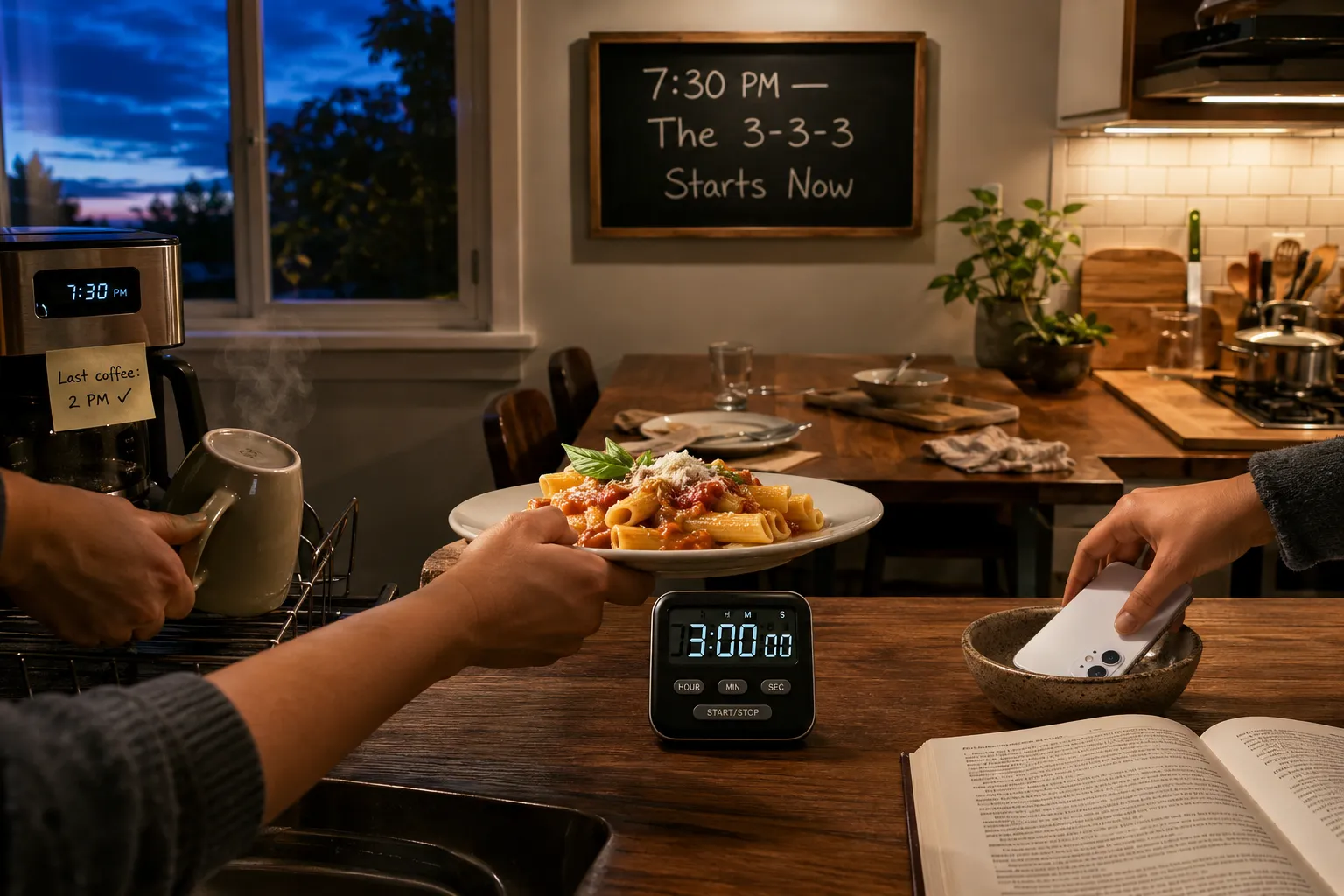
What Is the 3-3-3 Rule for Sleep?

The 3-3-3 rule for sleep is a simple pre-bed guideline to help you wind down faster and sleep more deeply:

3h
No caffeine 3 hours before bed
Caffeine blocks adenosine, the chemical that builds sleep pressure. Even if you fall asleep fine, an evening coffee often reduces time in deep sleep without you realizing it.
3h
No large meals 3 hours before bed
Digestion raises core body temperature, which works against the natural temperature drop your body needs to initiate sleep. A light snack is fine — a heavy dinner is not.
30m
No screens 30 minutes before bed
Blue light from phones delays melatonin production. More importantly, scrolling keeps your brain alert when it should be winding down.

Sticking to these three rules is one of the fastest ways to improve sleep quality. For the full evidence-based checklist, see our Sleep Hygiene Tips guide.

Is 9:30 PM to 4:30 AM Enough Sleep?

9:30 PM to 4:30 AM is exactly 7 hours of sleep. For most adults, this falls within the recommended range of 7 to 9 hours — so yes, it can be enough sleep, depending on the person. Here's how that maps to sleep cycles:

DurationCyclesNotes
7 hours~4.67 cyclesAcceptable for many adults
7.5 hours5 complete cyclesSweet spot for feeling refreshed ⭐

The bigger question is whether your schedule is consistent. Going to bed and waking up at the same times every day — even on weekends — has a larger impact on sleep quality than squeezing in extra minutes here and there. Use our Sleep Schedule Builder to plan a consistent weekly routine.

Does Closing Your Eyes Count as Sleep?

No — closing your eyes does not count as sleep. Sleep is a specific biological state measured by brain activity, and it looks very different from simply lying still with your eyes shut. When you close your eyes and rest, your brain remains in an active, alert pattern similar to wakefulness.

True sleep — even the lightest Stage 1 — involves measurable changes in brain waves (shifting to theta waves), a drop in muscle activity, a slowing heart rate, and a reduction in your ability to respond to the environment. That said, lying still with eyes closed does have real benefits: it reduces sensory input, lowers mental load, and slows heart rate slightly.

Sleep tip: If you're lying in bed, eyes closed, but feeling wide awake for more than 20 minutes, sleep specialists recommend getting up and doing something calm in dim light rather than forcing it. Lying awake in bed trains your brain to associate the bed with wakefulness. If this happens regularly, read our guide to insomnia.

What Time Should You Go to Bed?

Your ideal bedtime depends on two things: when you need to wake up, and how many sleep cycles you want to complete. For most adults aiming for 7.5 hours (five complete cycles):

Wake-Up TimeIdeal Bedtime (5 cycles)
5:00 AM9:16 PM
5:30 AM9:46 PM
6:00 AM10:16 PM
6:30 AM10:46 PM
7:00 AM11:16 PM
7:30 AM11:46 PM
8:00 AM12:16 AM

These times account for the ~14 minutes it takes the average person to fall asleep after getting into bed. Your personal fall-asleep time may be shorter or longer — you can adjust this in our Sleep Cycle Calculator. To calculate your exact ideal bedtime from a wake-up time, use the Bedtime Calculator.

What Are the Signs You're Not Getting Enough Sleep?

Sleep debt builds up quietly. Most people adapt to feeling slightly tired and stop noticing it. Here are the most reliable signs:

During the day
  • You need an alarm and hit snooze more than once
  • You feel mentally slow or forgetful before noon
  • You fall asleep within minutes of sitting quietly
  • You rely on caffeine to feel functional
  • Irritability — one of the earliest signs
Longer-term patterns
  • You sleep significantly longer on weekends
  • You get sick more often than you used to
  • Your appetite has increased unexpectedly
  • Trouble concentrating at work or school

If you regularly sleep more than two hours longer on weekends, your body is telling you it's not getting enough during the week. Our Sleep Debt Calculator can help you measure how much you've accumulated.

How to Use a Sleep Calculator Effectively

The calculator gives you target times — but the results only work if your sleep habits support them:

1
Set a consistent wake-up time first
Most sleep scientists recommend anchoring your schedule around a fixed wake-up time, not a fixed bedtime. Your wake time regulates your circadian rhythm more reliably than when you get into bed.
2
Use bedtime options as a window, not an exact minute
If the calculator says 10:46 PM, getting into bed between 10:30 and 11:00 PM is fine. Your exact sleep onset varies nightly.
3
Account for your real fall-asleep time
The default 14 minutes is an average. If you typically take 30 minutes to fall asleep, adjust the settings accordingly.
4
Don't use the calculator to justify less sleep
A 6-hour window that ends on a cycle boundary is still less sleep than your body needs. Cycle timing matters, but total duration matters too.

What Is Chronotype and Why Does It Affect Your Sleep Schedule?

Your chronotype is your body's natural tendency toward being a morning person or a night person. It's largely genetic and influences when your body naturally wants to sleep and wake.

🦁
Lions (Early chronotype)
Wake up easily before 6 AM, peak energy in the morning, fade by evening.
🐻
Bears (Intermediate)
Follow the solar cycle roughly. Most of the population falls here.
🐺
Wolves (Late chronotype)
Struggle to wake before 8 or 9 AM, most productive in the evening.
🐬
Dolphins (Light sleeper)
Irregular sleep, prone to waking, often anxious about sleep quality.

If your required sleep schedule conflicts with your chronotype, no amount of willpower fully compensates. Take our Chronotype Calculator to find yours.

How to Improve Sleep Quality (Beyond Just the Timing)

Getting the timing right is one piece of the puzzle. Sleep quality — measured in part through sleep efficiency, the ratio of actual sleep time to total time spent in bed — matters just as much as duration. A few habits that research consistently backs:

  • Keep the room cool. Your core body temperature needs to drop 1–2°F to initiate sleep. Most people sleep best between 65–68°F (18–20°C).
  • Block light completely. Even small amounts of light — a charging LED, streetlight through thin curtains — can suppress melatonin and reduce deep sleep.
  • Limit alcohol close to bedtime. Alcohol helps some fall asleep faster but fragments sleep in the second half, significantly reducing REM sleep.
  • Get morning light within an hour of waking. Natural light in the morning anchors your circadian rhythm. Even 10 minutes outside makes a difference.
  • Don't go to bed unless you're sleepy. Lying in bed wide awake creates a mental association between bed and alertness. Wait until you feel genuinely drowsy.

For a complete list, read our Sleep Hygiene Guide with 20 science-backed habits.

Sleep Calculator Tools on This Site

We've built a full set of free tools to cover every part of your sleep schedule:

Find Your Ideal Bedtime or Wake-Up Time

Because sleep runs in 90-minute cycles, your best wake-up moment is the end of a complete cycle, not a round number on the clock. If you know when you need to wake, the bedtime calculator tells you when to go to bed; if your bedtime is fixed, the wake-up time calculator shows the best times to rise. To see your night stage by stage, try the sleep cycle calculator or read how the 4 stages of sleep work. For exact times, see what time to sleep to wake up at 5 AM, 6 AM, or 7 AM — or what time to wake up if you sleep at 9 PM, 11 PM, or midnight.

Are You Getting Enough Sleep?

Most adults need seven to nine hours, but the right amount depends on your age and biology — see how much sleep you need by age. If you suspect you're running short, our science-backed guides explain exactly what happens on 4 hours, 5 hours, 6 hours, or 7 hours of sleep, and the sleep debt calculator reveals how much rest you may owe your body. Still tired after a full night? Learn why you wake up tired and the most common reasons you feel so tired during the day.

Build a Consistent Sleep Routine

Lasting results come from a steady schedule, not a one-off fix. Keeping the same wake time every day anchors your circadian rhythm, and morning light plus a calm, screen-free wind-down does the rest. If your schedule has drifted, follow our 7-day plan to fix your sleep schedule or create a personalised plan with the sleep schedule builder. To wake up sharper, learn how to beat sleep inertia, fall asleep faster, and pin down the best time to wake upfor your body. Pair these habits with cycle-aligned timing and you'll get far steadier energy than chasing a single number of hours ever delivers.

Related Sleep Guides

View all guides →

Frequently Asked Questions

What time should I go to bed if I wake up at 6 AM?+

If you need to wake up at 6 AM, the best bedtimes to complete full 90-minute sleep cycles are 8:46 PM (for 9 hours of sleep), 10:16 PM (for 7.5 hours of sleep), or 11:46 PM (for 6 hours of sleep). These times include 14 minutes to fall asleep.

How long is a full sleep cycle?+

A full sleep cycle lasts approximately 90 minutes. During this time, your body moves through light sleep, deep sleep, and REM sleep. Waking up at the end of a cycle helps you feel refreshed rather than groggy.

Can I catch up on missed sleep?+

Yes, you can recover from short-term sleep debt by sleeping a little longer the next few nights or taking a 90-minute nap. However, chronic long-term sleep debt cannot be completely erased just by sleeping in on the weekends.

Is it better to wake up early or sleep in?+

It is better to maintain a consistent wake-up time every day, even on weekends. Consistency helps regulate your circadian rhythm, making it easier to fall asleep at night and wake up naturally in the morning.

How many sleep cycles should I get per night?+

Most adults do best with 5 complete sleep cycles per night, which works out to 7.5 hours of sleep (not counting the time to fall asleep). Four cycles (6 hours) is often enough for some people but leaves others running a sleep deficit. Six cycles (9 hours) is ideal if you are recovering from illness, intense exercise, or accumulated sleep debt.

What happens if I wake up in the middle of a sleep cycle?+

Waking up mid-cycle — particularly during Stage 3 deep sleep — causes sleep inertia, which is that heavy, foggy feeling that can last anywhere from a few minutes to over an hour. This is why some people feel terrible after 8 hours of sleep if their alarm fires at the wrong moment. Timing your alarm to the end of a cycle avoids this.

Can I use a sleep calculator for naps?+

Yes. Naps follow the same cycle logic. A 20-minute nap keeps you in Stage 1 and 2 (light sleep), which is easier to wake from and does not cause grogginess. A 90-minute nap completes one full cycle, including deep sleep and REM, and is genuinely restorative. Naps between 30 and 60 minutes tend to cause the most grogginess because you wake up mid-cycle.

Does everyone have a 90-minute sleep cycle?+

The 90-minute figure is an average. Individual cycle lengths range from about 80 to 100 minutes. Early cycles are often slightly shorter, later ones slightly longer. For most people, 90 minutes is close enough that using it as a baseline gives useful results.

Is 6 hours of sleep enough for adults?+

For most adults, 6 hours is consistently less than the body needs. Research shows that people sleeping 6 hours a night for two weeks accumulate the same cognitive impairment as going completely without sleep for 24 hours. A small percentage of the population (roughly 1–3%) genuinely thrives on 6 hours due to a genetic variant, but it is rare.

What is sleep debt and can you pay it back?+

Sleep debt is the accumulated difference between how much sleep you needed and how much you got. You can recover from short-term sleep debt by sleeping longer over the following days. Chronic, long-term sleep debt is harder to fully reverse. The best approach is to prevent debt from accumulating rather than trying to pay it back in bulk.

How Much Sleep Do You Need by Age?

Recommended daily sleep hours per the National Sleep Foundation & American Academy of Sleep Medicine

Age GroupAge RangeRecommended HoursSleep Cycles
Newborn0–3 months14–17 hours9–11 cycles
Infant4–11 months12–15 hours8–10 cycles
Toddler1–2 years11–14 hours7–9 cycles
Preschool3–5 years10–13 hours6–8 cycles
School Age6–13 years9–11 hours6–7 cycles
Teenager14–17 years8–10 hours5–6 cycles
Young Adult18–25 years7–9 hours5–6 cycles
Adult26–64 years7–9 hours5–6 cycles
Older Adult65+ years7–8 hours4–5 cycles
Source: National Sleep Foundation & AASM guidelines · Sleep Calculator by Age. Individual needs vary. Consult a doctor if you have persistent sleep issues.

How Much Sleep Do You Actually Need?

Age, activity level, and health all affect your ideal sleep duration. Read our science-backed guide.

Read the Sleep Guide →