

Fact-Checked & Clinical Guidelines Aligned
Content rigorously reviewed to ensure alignment with clinical guidelines published by the National Sleep Foundation (NSF) and the American Academy of Sleep Medicine (AASM).
Average Wake-Up Time
What is the average wake-up time worldwide? Discover when most people wake up, how much sleep you really need, and 5 science-backed tips to wake up feeling refreshed every morning.
Average Wake-Up Time: What It Is, What It Means & How to Wake Up Refreshed
You roll over, silence the alarm, and wonder — is this even a normal time to wake up? Whether you're an early bird rising at 5 AM or someone who can't peel themselves off the pillow before 9, you've probably wondered what the average wake-up time really looks like.
The truth is: your wake-up time affects your mood, energy, focus, and long-term health far more than most people realise. In this guide, we break down global wake-up data, explain how much sleep different people actually need, and share 5 expert-backed tips to make waking up feel less like punishment.
Table
- What Is the Average Wake-Up Time Globally?
- At What Time Do Most People Fall Asleep?
- How Much Sleep Do You Actually Need?
- Do You Wake Up Fresh or Exhausted?
- 5 Tips to Waking Up Refreshed
- Calculate Your Perfect Wake-Up Time
- FAQ
What Is the Average Wake-Up Time Globally?
Most people around the world wake up somewhere in the 7 o'clock hour. According to world population data, the US average wake-up time sits at around 7:20 AM — right in the middle of the global pack.
But it varies significantly by country:
| Country | Average Wake-Up Time |
|---|---|
| Costa Rica / Colombia | Before 7:00 AM 🌅 |
| United States | ~7:20 AM |
| United Kingdom | ~7:30 AM |
| Spain / Greece | ~8:15–8:30 AM |
| Saudi Arabia / Kuwait | ~8:30 AM |
Insight: Early risers in Central and South America tend to wake up before 7 AM, while Mediterranean and Middle Eastern countries average closer to 8:30 AM. Despite the differences, the entire world is up and moving by 9 AM.
At What Time Do Most People Fall Asleep?
To understand wake-up times, you have to understand bedtimes. According to sleep tracking data from Withings:
- Ages 20–24 go to sleep at around 12:20 AM and wake up at 8:17 AM
- Ages 55–59 go to sleep closer to 11:00 PM and wake up as early as 7:08 AM
- Ages 65+ go to bed around 11:23 PM but wake later as retirement removes strict schedules
Insight: Bedtimes get earlier as we age — but so do wake times. Teenagers and young adults are biologically wired to sleep later, while middle-aged adults tend to be the earliest risers.
On weekends, nearly everyone pushes later. The average Sunday wake-up time is 8:20 AM — a full 35–50 minutes later than weekdays. That "lazy Sunday" is real, and your body knows it.
How Much Sleep Do You Actually Need?
This is the most misunderstood part of wake-up times. Waking up at 6 AM isn't healthy if you went to bed at 2 AM.
According to Henry Ford Health sleep specialist Cynthia Fellman-Couture, almost everyone needs between 7 and 9 hours of sleep per night. Some people function well on 7; others genuinely need 9.
Here's a quick age-based guide:
| Age Group | Recommended Sleep |
|---|---|
| Teens (14–17) | 8–10 hours |
| Young Adults (18–25) | 7–9 hours |
| Adults (26–64) | 7–9 hours |
| Older Adults (65+) | 7–8 hours |
Insight: Sleep isn't just about hours — it's about cycles. Your body moves through 90-minute sleep cycles. Waking up at the end of a cycle (rather than mid-cycle) is what makes you feel refreshed. Use our Sleep Calculator to find your ideal wake-up time based on complete sleep cycles.
Do You Wake Up Fresh — or Exhausted?
Here's an honest question: when your alarm goes off, do you feel ready, or does it feel like you've been hit by a truck?
According to Henry Ford Health, if you're sleep-deprived, it takes much longer to feel alert when you wake up — even after a full night. This is because during sleep, blood flow to the brain decreases. When you wake, consciousness returns instantly, but alertness lags behind. The more sleep-deprived you are, the longer that lag.
Signs you're waking up sleep-deprived:
- You hit snooze 2+ times every morning
- You feel foggy or irritable for the first hour
- You need caffeine before you can function
- You feel tired again by early afternoon
- You sleep significantly longer on weekends to "catch up"
Insight: Regularly needing to "catch up" on weekends is a sign of chronic sleep debt. According to a 2019 global Philips survey, 80% of adults worldwide want to improve their sleep quality — and 64% have a completely different sleep schedule on weekends.
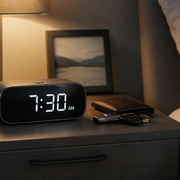 An alarm clock showing 7:30 AM — close to the global average wake-up time
5 Tips to Waking Up Refreshed (Science-Backed)
Based on guidance from Henry Ford Health sleep specialists, here are the five most effective strategies for waking up feeling genuinely rested:
1. Work With Your Sleep Cycle, Not Against It↓
Your body's natural circadian rhythm is designed to wake up with light and sleep in darkness. Step into sunlight within a few minutes of waking — this signals your brain that it's daytime and triggers alertness hormones naturally.
If you work nights, keep your room dark during day-sleep hours, and use bright light during your waking hours to mimic the same effect.
Pro tip: Use our Sleep Cycle Calculator to find a wake-up time that lands at the end of a 90-minute sleep cycle — so you wake up naturally refreshed instead of groggy mid-cycle.
2. Stop Hitting Snooze — Seriously↓
It feels like you're getting more rest, but you're not. According to Henry Ford Health sleep coordinator Cynthia Fellman-Couture, repeatedly hitting snooze actually makes it harder to feel awake and alert.
Here's why: each snooze brings you back into light sleep — sleep that's almost immediately interrupted again. Over a week, 10 minutes of snoozing daily adds up to more than an hour of broken, useless sleep.
Set your alarm for when you actually need to get up — and get up when it rings.
3. Move Your Body Within 30 Minutes of Waking↓
You don't need a full gym session. Even 10 minutes of movement — a short walk, light stretching, or a few yoga poses — can dramatically improve how awake and alert you feel.
Exercise improves circulation, produces mood-boosting hormones, and accelerates the transition from sleep inertia to full alertness. Morning movers consistently report better energy levels throughout the entire day.
4. Eat a Real Breakfast — Not Just Coffee↓
After 7–9 hours of fasting, your brain and body need real fuel. Starting the day with only caffeine or a sugary pastry leads to an energy crash by mid-morning — which many people mistake for "still being tired."
A solid breakfast includes a mix of protein, complex carbs, and healthy fat. Think: oatmeal with nuts and berries, scrambled eggs on whole-grain toast, or Greek yogurt with fruit. This stabilises blood sugar and keeps your energy steady through the morning.
5. Do One Thing You Actually Enjoy in the Morning↓
Whether it's a strong coffee, a hot shower, journaling, playing with your pet, or reading 10 pages of a book — building something enjoyable into your morning routine gives your brain a reason to look forward to waking up.
Over time, your body begins to anticipate the morning routine and naturally shifts toward earlier, easier wake-ups. This is one of the most underrated sleep hygiene tips that sleep specialists recommend.
Calculate Your Perfect Wake-Up Time
Not sure when to set your alarm? Stop guessing. Our free Sleep Calculator at GetSleepCalculator.net calculates the ideal wake-up times based on 90-minute sleep cycles — the same method used by wakeupti.me and sleep researchers worldwide.
Enter your bedtime → get your best wake-up windows → wake up refreshed.
👉 Try the Free Sleep Calculator →
FAQ
What is the average wake-up time in the US?↓
The average American wakes up at around 7:20 AM on weekdays. On weekends, this shifts later — closer to 8:00–8:30 AM for most adults.Is waking up at 6 AM healthy?↓
It depends entirely on when you went to sleep. If you slept at 10:30 PM, waking at 6 AM gives you 7.5 hours — which is healthy. If you slept at 1 AM, 6 AM is too early and will leave you sleep-deprived over time.Why do I feel more tired after sleeping longer?↓
This is called sleep inertia — a groggy, disoriented feeling caused by waking mid-sleep-cycle. Sleeping in too long can also disrupt your circadian rhythm. The fix is to wake up at the end of a 90-minute cycle using a sleep calculator.What time should I wake up to feel refreshed?↓
The best wake-up time is one that completes a full 90-minute sleep cycle. For example, if you fall asleep at 11:00 PM, ideal wake-up times are 6:00 AM (7 cycles) or 7:30 AM (6 cycles). Use our **[Sleep Calculator](https://getsleepcalculator.net)** to find yours.How many sleep cycles do I need per night?↓
Most adults need 5 complete sleep cycles per night — that's 7.5 hours. Some people do well on 4 cycles (6 hours); others need 6 cycles (9 hours). Quality matters as much as quantity.Does waking up at the same time every day really help?↓
Yes — significantly. A consistent wake time anchors your circadian rhythm. Your body begins to prepare for waking (by raising cortisol and body temperature) before your alarm even goes off, making mornings far easier.Insight: According to the NHS, going to bed and waking up at the same time every day — including weekends — is one of the most powerful things you can do for long-term sleep health. Consistency beats "sleeping in" every time.
How Wake-Up Times Vary Around the World
There is no single global wake-up time, because the average is pulled in different directions by geography, culture, and lifestyle. Countries with earlier work and school start times naturally show earlier average wake-ups, while cultures with later evening routines wake later to match. Daylight plays a role too: people tend to rise earlier in long summer days and later through dark winters, as morning light is one of the strongest signals telling the body to wake. Age shifts the pattern as well — teenagers are biologically wired toward later sleep and wake times, while older adults often wake earlier than they did in their youth.
Even within a single person, wake-up times swing across the week. Most people wake earlier on workdays and noticeably later on weekends, a gap researchers call social jet lag. The larger that gap, the more it disrupts the body clock, which is part of why Monday mornings feel so harsh. So while it's interesting to know the average, it tells you less about what's healthy than your own consistency does.
Why Your Wake Time Matters More Than You Think
Your wake-up time is the single most powerful anchor for your entire circadian rhythm. Because morning light exposure resets the body clock each day, the time you get up effectively sets the timing of everything that follows — your hormone release, your energy peaks, and when you'll naturally feel sleepy that night. This is why sleep experts often say that fixing your wake time does more for your sleep than fixing your bedtime. A consistent wake-up, reinforced with bright morning light, gradually pulls your whole rhythm into a stable, predictable pattern.
How to Find and Keep Your Ideal Wake Time
Rather than aiming for an average, find the wake time that completes your sleep cycles and fits your life, then protect it. Work backwards from a realistic bedtime in full 90-minute cycles to land on a wake-up that leaves you in light sleep, and keep it within about thirty minutes every day — weekends included. Get outside into daylight soon after waking to lock the rhythm in, and keep evenings dim so melatonin can rise on schedule. Done consistently, this turns your wake-up from a daily battle with the alarm into something that increasingly happens on its own.
Sources: Henry Ford Health — 5 Tips to Waking Up Refreshed | NHS Every Mind Matters — Sleep | Withings Sleep Study | World Population Review — Average Wake-Up Time by Country | wakeupti.me
Calculate Your Perfect Sleep & Wake Times
Put this research into practice immediately. Our scientific calculators align your sleep with natural 90-minute REM cycles.
Related Articles
Why You Wake Up Tired Even After 8 Hours of Sleep
8 common hidden causes of morning fatigue — and exactly how to fix each one.
8 min read read →How to Fall Asleep Faster: 12 Science-Backed Tips
Reduce your sleep onset time from 30+ minutes to under 10 minutes with these evidence-based techniques.
7 min read read →How to Fix Your Sleep Schedule in 7 Days
A step-by-step protocol using anchor wake times, morning light, and sleep pressure to reset your schedule.
7 min read read →