
Fact-Checked & Clinical Guidelines Aligned
Content rigorously reviewed to ensure alignment with clinical guidelines published by the National Sleep Foundation (NSF) and the American Academy of Sleep Medicine (AASM).
How to Quickly Fix a Severely Messed Up Sleep Cycle
Is your sleep cycle completely off? Learn how to quickly fix a severely messed-up sleep cycle using science-backed methods — and understand how poor sleep destroys your mood and mental health.
How to Quickly Fix a Severely Messed Up Sleep Cycle (Science-Backed Guide)
Also known as: how to reset sleep schedule, fix disrupted circadian rhythm, sleep cycle repair
Last updated: June 2026 | 10 min read
You're sleeping at 4 AM and waking up at noon. Or you can't sleep at all until exhaustion forces you down. Or you wake up every two hours through the night.
Sound familiar? Your sleep cycle is messed up — and it's not just ruining your rest. It's quietly damaging your mood, memory, immune system, and mental health every single day you let it continue.
The good news: your circadian rhythm is not permanently broken. In this guide, we explain exactly what causes a disrupted sleep cycle, what it does to your brain and body, and the fastest science-backed methods to reset it — starting tonight.
Table of Contents
- What Is a Messed Up Sleep Cycle?
- What Causes a Disrupted Sleep Cycle?
- Good Sleep vs Messed Up Sleep — Side by Side
- How Sleep Deprivation Impacts Mental Health
- Sleep and Mood — The Two-Way Trap
- What Helps You Get a Good Night's Sleep?
- How to Quickly Fix a Severely Messed Up Sleep Cycle
- How Long Does It Take to Fix a Messed Up Sleep Cycle?
- Use Our Sleep Calculator to Rebuild Your Schedule
- FAQ
- Keeping Your Sleep Cycle on Track After the Reset
What Is a Messed Up Sleep Cycle?
Your body runs on an internal 24-hour clock called the circadian rhythm. This clock controls when you feel sleepy, when you feel alert, when your body temperature rises and falls, and when hormones like melatonin and cortisol are released.
When this clock gets disrupted — through irregular sleep times, night shifts, travel, stress, or excessive screen use — your sleep cycle becomes desynchronised. You stop feeling sleepy at the right time, you can't stay asleep when you do, and you wake up feeling like you never slept at all.
Signs your sleep cycle is severely messed up:
- You can't fall asleep before 2–4 AM
- You sleep through the morning and feel groggy all day
- You wake up multiple times through the night
- You feel exhausted even after 8+ hours in bed
- Your energy crashes and spikes at random times
- You feel irritable, anxious, or emotionally flat
Insight: A disrupted circadian rhythm doesn't just affect how tired you feel — it affects virtually every biological process in your body. Your immune function, metabolism, hormone production, and emotional regulation all depend on your body clock being properly synced.
What Causes a Disrupted Sleep Cycle?
Understanding the cause helps you fix it faster. The most common culprits:
| Cause | How It Disrupts Sleep |
|---|---|
| Irregular sleep/wake times | Confuses your body clock — it stops knowing when to release melatonin |
| Excessive screen use at night | Blue light suppresses melatonin production for 2–3 hours |
| Shift work or travel (jet lag) | Forces your body to operate against its natural time zone |
| High stress or anxiety | Elevates cortisol, keeping your nervous system alert at night |
| Too much caffeine or alcohol | Disrupts deep sleep and REM cycles even if you fall asleep fine |
| Long daytime naps | Reduces "sleep pressure" — the natural drive to sleep at night |
| No morning light exposure | Fails to reset your circadian clock each morning |
Good Sleep vs Messed Up Sleep — Side by Side

✅ Healthy Sleep — Deep, uninterrupted, cycle-aligned rest
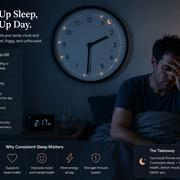
❌ Messed Up Sleep — Fragmented, restless, cycle-disrupted nights
How Sleep Deprivation Impacts Mental Health
A disrupted sleep cycle doesn't just make you tired. According to Columbia University Department of Psychiatry, sleep problems can directly contribute to the onset and worsening of serious mental health conditions — including depression, anxiety, and even suicidal ideation.
Columbia psychologist Dr. Elizabeth Blake Zakarin explains it this way: "Just like our electronics need to be charged, sleep may recharge or reset the brain to optimize functioning."
Here's what chronic sleep deprivation does to your mental health:
| Mental Health Impact | What It Looks Like |
|---|---|
| Increased anxiety | Racing thoughts, heightened stress response, inability to calm down |
| Depression risk | Low mood, loss of interest, emotional numbness |
| Impaired memory | Forgetting tasks, struggling to concentrate at work or school |
| Emotional dysregulation | Overreacting to small frustrations, mood swings |
| Reduced resilience | Everyday stressors feel overwhelming and unmanageable |
| Suicidal ideation risk | Chronic sleep loss is linked to increased risk in vulnerable individuals |
Insight: According to Columbia Psychiatry, poor sleep increases negative emotional responses to stressors and decreases positive emotions. Sleep helps maintain critical cognitive skills — attention, learning, and memory — that fall apart when you're chronically sleep-deprived.
Sleep and Mood — The Two-Way Trap
One of the most dangerous things about a messed-up sleep cycle is that it creates a self-reinforcing loop.
Poor sleep → worse mood → harder to sleep → even worse mood.
According to research from Harvard Medical School's Healthy Sleep programme, University of Pennsylvania researchers found that subjects limited to just 4.5 hours of sleep per night for one week reported feeling significantly more stressed, angry, sad, and mentally exhausted. When they returned to normal sleep, their mood improved dramatically.
The relationship runs both ways:
- Sleep affects mood: Even one bad night increases irritability, emotional reactivity, and negative thinking
- Mood affects sleep: Anxiety and stress raise cortisol, keeping your body aroused and awake when it should be winding down
Insight: Insufficient sleep lowers serotonin levels and increases cortisol production. Elevated cortisol then further disrupts your circadian rhythm — creating a vicious cycle of poor sleep, heightened anxiety, and worsening mood that compounds night after night if left unaddressed.
What Helps You Get a Good Night's Sleep?
Before jumping into the reset plan, here are the foundational habits that make good sleep possible. According to Columbia University Psychiatry, these evidence-based habits form the basis of healthy sleep:
✅ Keep a Consistent Sleep Schedule — Even on Weekends↓
This is the single most powerful sleep habit. Going to bed and waking up at the same time every day — including weekends — anchors your circadian rhythm. Your body begins preparing for sleep automatically at the right time, making it far easier to fall asleep and wake up naturally.
According to the NHS, consistency in sleep timing is one of the most effective long-term fixes for disrupted sleep.
✅ Set a Relaxing Bedtime Routine↓
Your brain needs a 30–60 minute transition from "alert mode" to "sleep mode." Establish a calming pre-bed routine: dim the lights, avoid screens, take a warm shower, read a physical book, or try gentle stretching. Avoid stressful conversations, work emails, or anything that raises cortisol in the hour before bed.
✅ Create a Sleep-Friendly Environment↓
Your bedroom should be dark, cool, and quiet. Aim for a room temperature of 65–68°F (18–20°C). Use blackout curtains to block light. Remove electronics from the bedroom — even standby lights can interfere with melatonin production.
✅ Exercise Regularly — But Not Too Late↓
Regular physical activity significantly improves sleep quality and helps regulate your circadian rhythm. However, intense exercise within 2–3 hours of bedtime can raise body temperature and cortisol, making it harder to fall asleep. Morning or early afternoon exercise is ideal.
✅ Cut Caffeine After 2 PM and Limit Alcohol↓
Caffeine stays active in your bloodstream for 5–6 hours. A coffee at 4 PM can still be disrupting your sleep at 10 PM. Alcohol may help you fall asleep but reduces deep sleep and REM — leaving you feeling unrefreshed even after a full night. Avoid both in the hours before bed.
How to Quickly Fix a Severely Messed Up Sleep Cycle
Here's the step-by-step reset plan — ordered from most to least impactful:
Step 1 — Choose a Fixed Wake Time and Commit to It Immediately↓
This is the starting point of every sleep reset. Pick a realistic wake-up time — say 7:00 AM — and set your alarm for it tomorrow. No matter what time you fell asleep, get up at 7:00 AM.
This is uncomfortable on day one. But it rapidly builds "sleep pressure" — the biological drive to sleep — which makes it much easier to fall asleep at a reasonable hour the following night.
Use our Sleep Calculator to find the ideal corresponding bedtime based on 90-minute sleep cycles.
Step 2 — Get Bright Light Within 15 Minutes of Waking↓
Light is the most powerful signal your body clock receives. Step outside or open your curtains immediately after waking. Even 10 minutes of morning sunlight resets your circadian clock and begins suppressing melatonin — making you feel genuinely alert within minutes.
At night, do the opposite: dim all lights, switch phones to night mode, and avoid bright overhead lighting at least an hour before bed.
Step 3 — Avoid Naps Longer Than 20 Minutes↓
When your sleep cycle is messed up, long naps feel tempting — but they reduce the sleep pressure you're building throughout the day, making it harder to fall asleep at your target bedtime.
If you must nap, keep it under 20 minutes and take it before 3 PM. Set an alarm — waking from deep sleep mid-nap causes grogginess and further disrupts nighttime sleep.
Step 4 — Try a "Sleep Reset" Night↓
If your sleep is severely off — sleeping at 5 AM and waking at 2 PM — you may need a more drastic reset. Stay awake for one full night and the following day, then go to bed at your target time (e.g., 10:30 PM). This rapidly resets your sleep pressure and re-anchors your circadian rhythm to the correct time.
This is uncomfortable but highly effective — most people find their sleep normalises within 2–3 days afterward.
Step 5 — Shift Your Bedtime Gradually (The Gentle Method)↓
If a full reset night isn't possible, shift your sleep schedule by 15–30 minutes earlier every 2–3 days until you reach your target bedtime. This is slower but gentler on your body — ideal for shift workers or people with anxiety who can't tolerate sleep deprivation.
Step 6 — Address the Root Cause↓
Fixing the sleep schedule without addressing why it broke will only lead to it breaking again. Common root causes to address:
- Stress or anxiety — consider journaling, therapy, or mindfulness practices before bed
- Screen use — implement a strict "no screens 45 minutes before bed" rule
- Caffeine — audit your intake and cut off by 2 PM
- Irregular schedule — if shift work is the cause, talk to your employer or doctor about circadian rhythm strategies
- Underlying conditions — if nothing works after 3–4 weeks, consult a GP or sleep specialist about CBT-I or other treatments
How Long Does It Take to Fix a Messed Up Sleep Cycle?
| Severity | Time to Reset |
|---|---|
| Mild disruption (1–2 weeks off) | 3–5 days with consistent schedule |
| Moderate disruption (1–3 months off) | 1–2 weeks |
| Severe disruption (months to years) | 2–4 weeks with strict consistency |
| With underlying condition (insomnia, anxiety) | 4–8 weeks with CBT-I or professional support |
Insight: According to Columbia Psychiatry, for chronic insomnia, Cognitive Behavioral Therapy for Insomnia (CBT-I) is the gold-standard first-line treatment — more effective than sleeping pills with longer-lasting results. If your sleep doesn't improve after 3–4 weeks of consistent effort, see your GP or a sleep specialist.
Use Our Sleep Calculator to Rebuild Your Schedule
Once you've chosen your target wake-up time, use our free Sleep Time Calculator at GetSleepCalculator.net to find the exact bedtime that completes a full 90-minute sleep cycle.
Enter your wake-up time → get your ideal bedtimes → rebuild your schedule night by night.
👉 Calculate Your Reset Bedtime Now →
FAQ
How long does it take to fix a messed up sleep cycle?↓
For mild disruptions, 3–5 days of consistent sleep and wake times is usually enough. For severe or long-term disruption, expect 2–4 weeks of strict consistency. If an underlying condition like anxiety or insomnia is involved, professional CBT-I treatment may take 4–8 weeks but produces lasting results.What is the fastest way to reset a sleep cycle?↓
The fastest method is a controlled sleep reset: stay awake for one full night and the following day, then go to bed at your target time. Combined with morning light exposure and no napping, most people see results within 2–3 nights. Use our **[Sleep Calculator](https://getsleepcalculator.net)** to find your ideal new bedtime.Can a messed up sleep cycle cause anxiety and depression?↓
Yes — significantly. According to Columbia University Department of Psychiatry, poor sleep can directly contribute to the onset and worsening of depression, anxiety, and other mental health disorders. The relationship is two-way: poor sleep worsens anxiety, and anxiety further disrupts sleep, creating a cycle that requires active intervention to break.What helps you get a good night's sleep?↓
The most evidence-backed habits are: a consistent wake time every day, morning sunlight within 15 minutes of waking, no screens 30–45 minutes before bed, a cool and dark bedroom, no caffeine after 2 PM, regular exercise (not within 2–3 hours of bedtime), and a relaxing pre-sleep routine. Consistency matters more than perfection.Is it bad to sleep at different times every night?↓
Yes. Irregular sleep timing — even if total hours are adequate — confuses your circadian rhythm and reduces sleep quality. Your body stops knowing when to prepare for sleep, leading to difficulty falling asleep, lighter sleep stages, and groggier mornings. A consistent schedule is more restorative than sleeping "when you can."Should I pull an all-nighter to reset my sleep?↓
Only as a last resort for severe disruption. A controlled all-nighter can rapidly rebuild sleep pressure and reset your body clock — but it carries short-term risks including extreme mood dips, impaired cognitive function, and difficulty driving. If you try it, plan to stay home, avoid driving, and go to bed at your target time (not before).When should I see a doctor about my sleep cycle?↓
See a GP or sleep specialist if your sleep doesn't improve after 3–4 weeks of consistent effort, if you snore loudly or stop breathing at night (possible sleep apnea), if your mood or mental health has significantly worsened, or if you feel unable to function during the day despite adequate sleep time.Insight: According to Harvard Medical School's Healthy Sleep research, when subjects who had been sleep-deprived for a week resumed normal sleep, they reported a dramatic improvement in mood. Fixing your sleep cycle doesn't just make you less tired — it can meaningfully restore your emotional wellbeing, resilience, and quality of life.
Keeping Your Sleep Cycle on Track After the Reset
Fixing a badly disrupted sleep cycle is only half the job; holding it steady is what prevents you from sliding straight back. The single most important habit is protecting a fixed wake time every single day, including weekends, because your wake-up — not your bedtime — is the master anchor for your body clock. Get bright light immediately after waking to lock the rhythm in, and keep evenings dim and screen-free so melatonin can rise on schedule.
Expect the occasional disrupted night and don't let it derail you — just return to your anchor wake time the next morning rather than letting one late night cascade into a week of them. Avoid long daytime naps while you're stabilising, since they steal the sleep pressure you need at night. With a consistent wake time, good light habits, and a calm wind-down, your reset schedule becomes self-sustaining instead of something you constantly have to repair.
Sources: Columbia University Psychiatry — How Sleep Deprivation Impacts Mental Health | Harvard Medical School — Sleep and Mood | NHS Every Mind Matters — Sleep | GetSleepCalculator.net
Calculate Your Perfect Sleep & Wake Times
Put this research into practice immediately. Our scientific calculators align your sleep with natural 90-minute REM cycles.
Related Articles
Why You Wake Up Tired Even After 8 Hours of Sleep
8 common hidden causes of morning fatigue — and exactly how to fix each one.
8 min read read →How to Fall Asleep Faster: 12 Science-Backed Tips
Reduce your sleep onset time from 30+ minutes to under 10 minutes with these evidence-based techniques.
7 min read read →How to Fix Your Sleep Schedule in 7 Days
A step-by-step protocol using anchor wake times, morning light, and sleep pressure to reset your schedule.
7 min read read →