How Long Until 3 AM
Wondering how long until 3 AM? Whether you're counting down or desperately trying to sleep before it hits — here's why 3 AM is the brain's favourite time to cause problems, and how to stop it.
How Long Until 3 AM? (And Why Your Brain Picks That Exact Moment to Ruin Everything)
"The worst thing in the world is to try to sleep and not to." — F. Scott Fitzgerald (who was clearly awake at 3 AM when he wrote this)
It is currently not 3 AM.
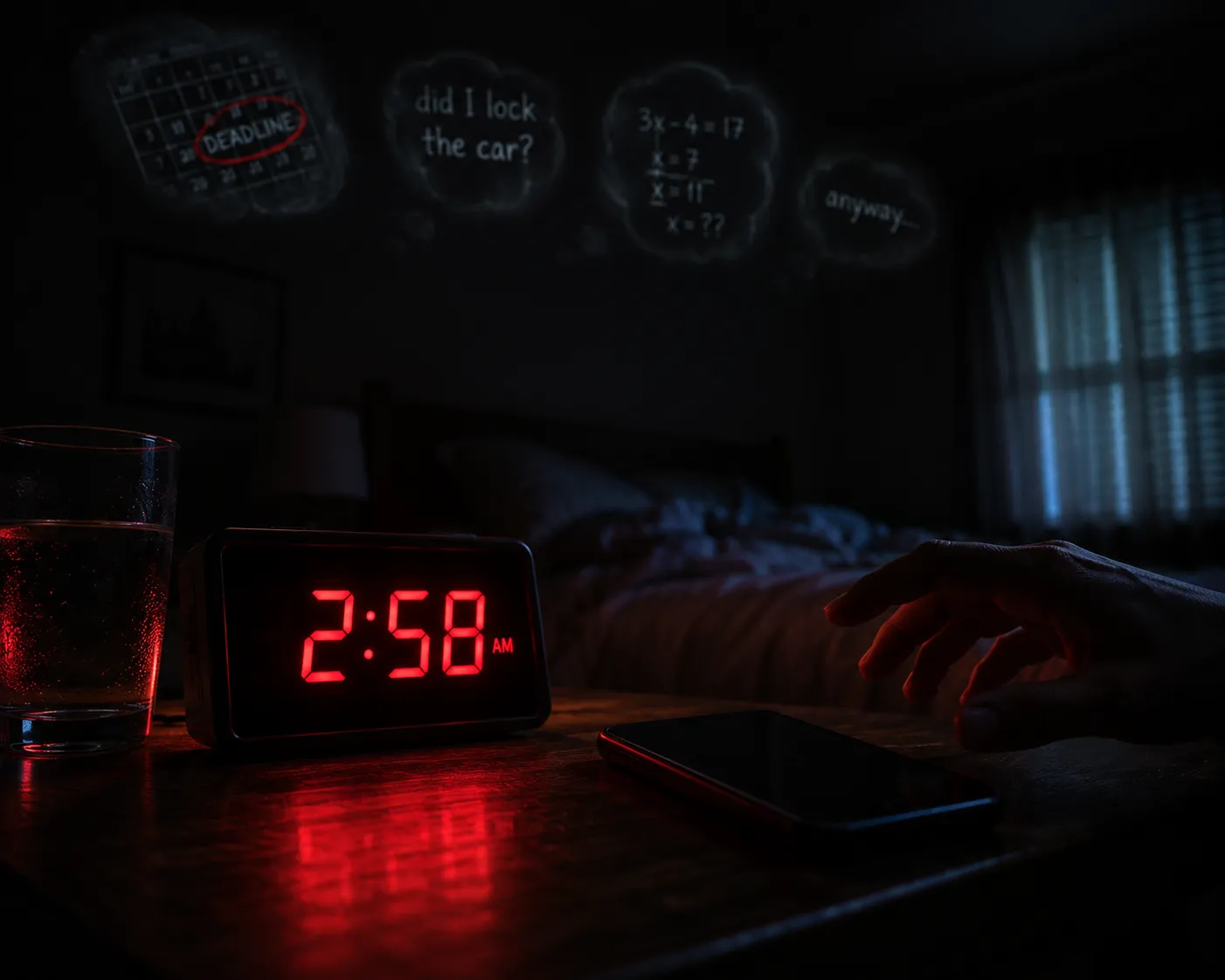
But you're thinking about it. Maybe you're lying in bed, watching the clock tick toward it with the quiet dread of someone who knows exactly what's coming. Maybe you're up late and doing the maths — wondering whether there's any point sleeping at all if 3 AM is this close. Maybe you've already been visited by 3 AM tonight and you're googling this in the dark with the brightness turned all the way down like a raccoon who has discovered the internet.
Whatever brought you here: welcome. You are among friends. Tired, slightly irrational, possibly emotional friends — but friends nonetheless.
Let's talk about 3 AM. What it is, why your brain loves it so much, and how to make sure it stops ambushing you quite so effectively.
First: How Long Until 3 AM?
The maths depends on what time it currently is, which — if you're reading this at 2:47 AM — you already know, and the answer is making you feel things.
Here's a quick reference:
| Current Time | How Long Until 3 AM |
|---|---|
| 10:00 PM | 5 hours — you could sleep a full cycle and still have time |
| 11:00 PM | 4 hours — still salvageable |
| Midnight | 3 hours — two complete sleep cycles if you sleep NOW |
| 1:00 AM | 2 hours — one cycle, technically |
| 2:00 AM | 1 hour — not enough for a cycle, still better than nothing |
| 2:47 AM | 13 minutes — put the phone down |
| 3:00 AM | You're already there. Hello. |
| 3:01 AM | It's getting further away but the damage is done |
The uncomfortable truth hiding in that table: every one of those times is still recoverable — if you stop what you're doing and sleep right now. Your body runs on 90-minute sleep cycles. Even one complete cycle before your alarm is better than zero. The question is never "is it worth sleeping?" The answer is always yes. The question is whether you're going to act on that before 3 AM makes the decision irrelevant.
Why 3 AM Specifically? (Your Brain Has Terrible Taste in Timing)
Here's the thing about 3 AM that nobody explains — it's not random. Your brain isn't picking this time out of spite. It has biology on its side, which is somehow more annoying.
The circadian trough.
Your circadian rhythm — the internal 24-hour biological clock that governs everything from alertness to body temperature to hormone release — hits its lowest point between approximately 3 and 5 AM. This is called the circadian trough, and it is the biological equivalent of your body's Wi-Fi dropping to one bar.
During the circadian trough:
- Core body temperature is at its lowest point of the day
- Melatonin is at or near its peak
- Cortisol is beginning its pre-dawn rise — but hasn't fully kicked in yet
- The immune system is doing its most active maintenance work
- Cognitive function, if you're awake, is at its absolute floor
This is why shift workers who are awake at 3 AM make more errors. Why most medical emergencies happen between 3 and 5 AM. Why driving at this hour is statistically one of the most dangerous things you can do. The human body was not designed to be operational at 3 AM. Evolution had the audacity to assume you'd be asleep.
And yet. Here you are.
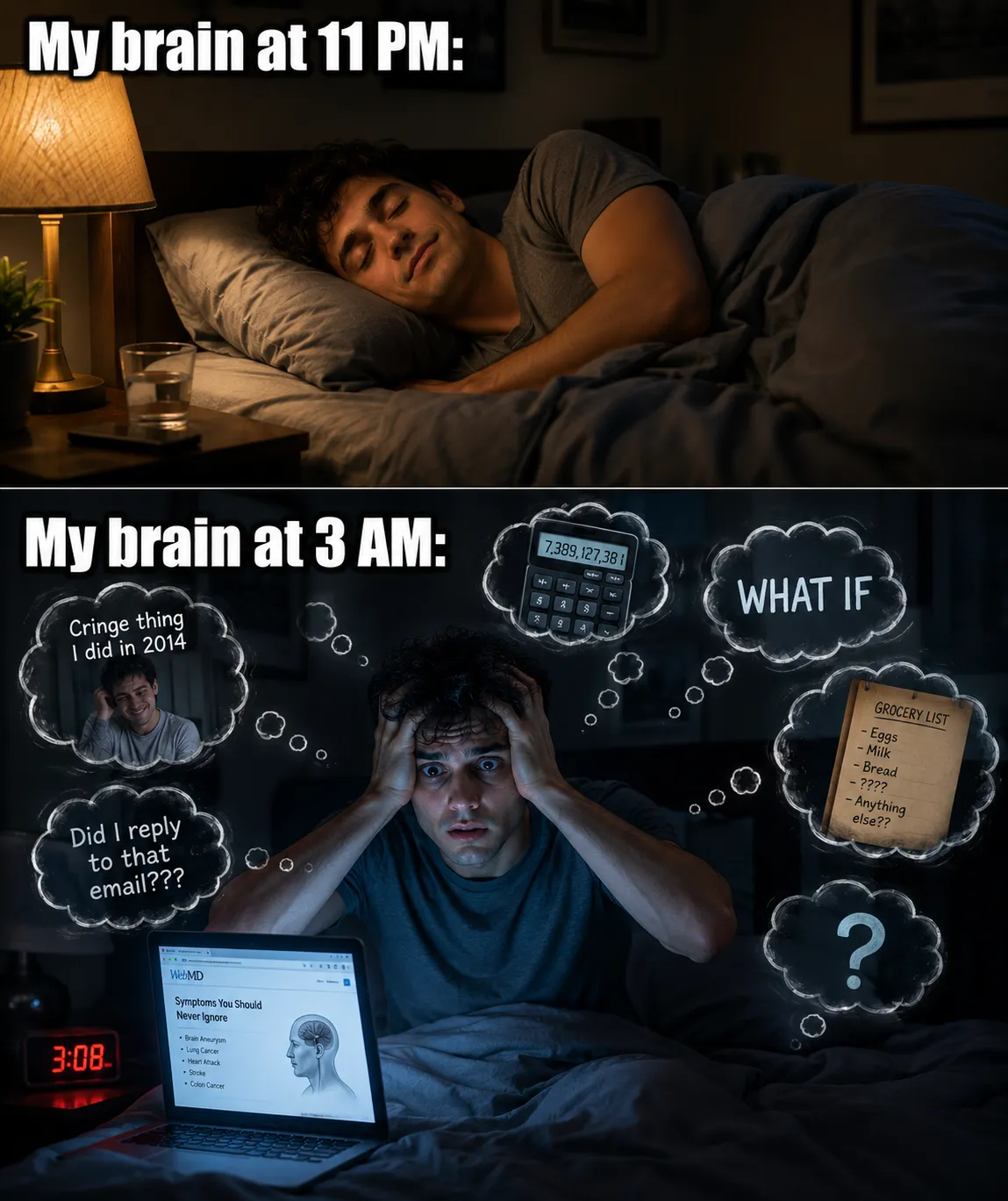
Your brain at 3 AM is like a smartphone running on 4% battery with seventeen apps open and no charger in sight. Technically on. Practically useless. And somehow still trying to process a notification from 2019.
The 3 AM Thought Spiral: A Field Guide
If you are awake at 3 AM, you are almost certainly experiencing one or more of the following:
The Inventory of Every Embarrassing Thing You've Ever Said Unprompted, in high definition, chronological order. Your brain at 3 AM has perfect recall for the thing you said at a party in 2011 and absolutely no capacity to remember where you put your keys.
The Urgent Financial Review Somehow, at 3 AM, your brain decides it's time to calculate exactly how much money you've spent on coffee in the last decade and what that would look like invested in an index fund. It cannot present solutions. It can only present the numbers, ominously.
The Health Spiral That thing on your arm is probably nothing. Or it's something. Either way, 3 AM is clearly the right time to decide. WebMD is there. It has opinions.
The Existential Check-In Are you happy? Are you doing the right things? Is this the life you meant to build? Your brain, running on fumes and ambient cortisol, has decided 3 AM is the optimal time to evaluate this. Spoiler: it will reach no conclusions. It will simply ask the questions and leave.
The Phantom To-Do List Seventeen things you forgot to do. None of which can be done at 3 AM. All of which feel urgent enough to prevent sleep. Your brain is basically a project manager with no concept of business hours.
The scientific term for this experience is psychophysiological arousal — the state where your mind is too activated to sleep even though your body desperately needs it. At 3 AM, the circadian trough means your body is at its least capable of sustaining wakefulness — and simultaneously, any anxiety or stress is experienced more intensely because the prefrontal cortex (the rational, regulatory part of your brain) is operating at reduced capacity.
In other words: 3 AM is not just late. It is the specific hour when your brain is least equipped to handle the thoughts it insists on having.
What 3 AM Is Actually Doing to You
Beyond the thought spirals — let's be precise about the cost.
If 3 AM is your unwanted wake-up time, you're losing the most valuable sleep of the night.
REM sleep — the stage critical for emotional processing, memory consolidation, creativity, and learning — dominates the later cycles of the night. A full night of sleep gives you progressively richer REM sleep in cycles 4, 5, and 6. When 3 AM wakes you and keeps you awake, those later cycles don't happen.
The result isn't just tiredness. It's:
- Impaired emotional regulation the following day (everything feels bigger than it is)
- Reduced creative problem-solving (your brain literally consolidates new connections during REM)
- Worse memory (the events of yesterday are less effectively stored)
- A shorter fuse on everything from traffic to email tone
According to the American Academy of Sleep Medicine, adults need 7 or more hours of sleep per night for optimal health. A 3 AM waking that keeps you up for an hour cuts that window significantly — and it cuts the most restorative part of it.
3 AM is expensive. Not in a dramatic way. In a quiet, cumulative, "why do I feel like this every day" kind of way.
How to Stop 3 AM From Finding You
Here's the practical section — because understanding why 3 AM is terrible is only useful if it leads somewhere actionable.
Fix your bedtime to a cycle endpoint. If you fall asleep at 11:15 PM, your natural cycle endpoints are 12:45 AM, 2:15 AM, 4:45 AM, and 6:15 AM. Waking at 3 AM puts you mid-cycle — right in deep sleep — which is why it feels so brutal. Adjusting your bedtime by 15–30 minutes can shift your cycles so 3 AM lands between cycles rather than inside one.
Address the cortisol before it addresses you. The pre-dawn cortisol rise that begins around 3–4 AM is partially responsible for early waking. High stress, alcohol consumption, blood sugar crashes, and a warm bedroom all amplify this rise. A cool room, no alcohol the night before, and a consistent sleep schedule all reduce the chance that the cortisol rise becomes a full wake-up.
The 20-minute rule. If you wake at 3 AM and aren't back to sleep within 20 minutes — get up. Do something quiet and dim. Return to bed when sleepy. Lying there fighting it trains your brain to associate the bed with wakefulness, which makes every future 3 AM worse. It feels counterintuitive. It is correct.
Don't check the time. Knowing it's 3:14 AM activates the problem-solving part of your brain ("how many hours until I have to get up?"), which is the exact opposite of what you need. Turn the clock away. Resist the phone. The time is either fine or it isn't, and checking doesn't change it — it just recruits your prefrontal cortex into the problem at the worst possible moment.

A Note to the People Counting Down TO 3 AM
Some of you are not dreading 3 AM. You're waiting for it.
Night shift workers. New parents. Students in the middle of something they probably shouldn't have left this late. People in different time zones waiting for a call. People who have simply, catastrophically, misjudged how long a project would take.
For you: the circadian trough is still coming. Your body will feel it between 3 and 5 AM regardless of your intentions. Performance drops, errors increase, and the temptation to make questionable decisions peaks.
Strategic caffeine — taken at the right moment, not continuously — can help bridge the trough. A 20-minute rest (even without full sleep) reduces acute impairment. And the moment the obligation ends: sleep. Not "one more thing." Not "I'll just finish this." Sleep.
The trough passes. But the debt it creates doesn't. Every hour of sleep missed between 2 and 6 AM is an hour of REM sleep that the night cannot give back.
FAQ
Why do I always wake up at 3 AM?↓
The circadian trough between 3 and 5 AM is a genuine biological phenomenon — your body temperature is at its lowest, melatonin is peaking, and cortisol is beginning its pre-dawn rise. This combination creates a natural vulnerability to waking. Alcohol, stress, a warm bedroom, blood sugar fluctuations, and sleep apnoea all amplify this tendency. If 3 AM waking is consistent, it's worth examining these factors — and your bedtime, which may be placing you mid-cycle at exactly that hour.
Is it worth sleeping if it's already 3 AM?↓
Yes — always. Even one complete 90-minute sleep cycle before your alarm provides meaningful restoration. Two cycles (3 hours) gives you REM sleep and physical recovery. Zero hours gives you nothing. The calculation is never "is it worth sleeping" — it's always worth it. The question is how to maximise what remains. Use the sleep calculator to find the best alarm time for the hours you have left.
Why does everything feel worse at 3 AM?↓
Because your brain is at its lowest functional point. The circadian trough reduces prefrontal cortex activity — the rational, regulatory part of the brain — while the body's stress systems are preparing for the pre-dawn cortisol rise. Anxiety, worry, and negative thoughts feel more intense because the brain has less capacity to regulate them. It is not a reflection of reality. It is a reflection of what 3 AM does to cognition.
How do I stop waking up at 3 AM?↓
Address the most common causes: alcohol before bed (suppresses REM and causes early waking), a warm bedroom (core temperature needs to drop for sustained sleep), stress and anxiety (elevates cortisol prematurely), and poor sleep timing (your cycles landing with a boundary near 3 AM). Fixing your bedtime to a cycle endpoint using the sleep calculator often shifts the cycle boundaries away from the 3 AM window entirely.
What should I do if I wake up at 3 AM and can't sleep?↓
Don't check the time if you can avoid it. If you're not asleep within 20 minutes, get up and do something quiet and dim — read a physical book, sit in low light. Return to bed when genuinely sleepy. Lying in bed fighting wakefulness trains your brain to associate bed with being awake, which compounds the problem over time. This is the core technique from CBT-I (cognitive behavioural therapy for insomnia) and it works — it just feels counterintuitive at 3:14 AM.
The Bottom Line
3 AM is not your friend. It is not a neutral hour. It is the specific point in the night where your body is at its lowest, your brain is at its least rational, your thoughts are at their most catastrophic, and your ability to do anything useful about any of it is at absolute zero.
The best thing to do with 3 AM is sleep through it.
The second best thing is to understand why it's happening — and fix the bedtime, the bedroom, the habits, and the cycle timing that keep handing it ammunition.
Put the phone down. Turn the clock away. The emails, the spirals, the financial calculations, the 2011 party — none of it is more solvable at 3:17 AM than it will be at 7:30 AM after a complete sleep cycle.
Sleep wins. Every time.
Sources: Circadian trough and human performance from Monk, Sleep, 2005. REM sleep distribution across the night from Carskadon & Dement, Principles and Practice of Sleep Medicine, 2011. Pre-dawn cortisol rise from Buckley & Schatzberg, Journal of Clinical Endocrinology & Metabolism, 2005. Sleep deprivation and emotional regulation from Yoo et al., Current Biology, 2007. Adult sleep recommendations from the American Academy of Sleep Medicine (AASM), 2015.
Calculate Your Perfect Sleep & Wake Times
Put this research into practice immediately. Our scientific calculators align your sleep with natural 90-minute REM cycles.
Related Articles
Sleep Efficiency Calculator: What Your Score Really Means
In bed for 8 hours but only sleeping 6? Calculate your sleep efficiency score, find out what's dragging it down, and fix it with simple, evidence-backed changes.
14 min read read →Sleep Debt Calculator: How Much Sleep Do You Actually Owe Yourself?
Running on 6 hours all week? Calculate your sleep debt and find out what it's actually costing you — plus the only evidence-backed way to genuinely pay it back.
14 min read read →Why You Need a Sleep Calculator (And Why Guessing Is Quietly Wrecking Your Sleep)
Still guessing your bedtime? A free sleep calculator tells you exactly when to sleep and wake up based on your cycles — no guesswork, no groggy mornings.
14 min read read →