
Fact-Checked & Clinical Guidelines Aligned
Content rigorously reviewed to ensure alignment with clinical guidelines published by the National Sleep Foundation (NSF) and the American Academy of Sleep Medicine (AASM).
How Much Sleep Do Adults Need?
How much sleep do adults actually need? Science says 7–9 hours — but timing, age, and sleep quality matter just as much as the number. Here’s the full, honest picture.
How Much Sleep Do Adults Need?
          “A good laugh and a long sleep are the two best cures for anything."
                                                                     — Irish Proverb
You’ve heard the number your whole life. Eight hours. Get your eight hours. Eight hours or you’re basically a walking health hazard.
But then you know people — real people, not lab mice — who swear by six and seem genuinely fine. And you know others who sleep nine hours and still drag themselves through the day like they’ve been mildly anesthetized. And then there’s you, lying awake at 1 AM, wondering whether thinking about sleep means you’re not getting enough of it.
So what’s the actual answer?
The real answer is both simpler and more complicated than "eight hours." It depends on your age, your biology, your sleep quality, and — critically — when your alarm goes off relative to your sleep cycle. The number matters. But it's not the whole story.
Here's everything you actually need to know.
The Official Answer: What the Experts Say
Let’s start with the science before we complicate it.
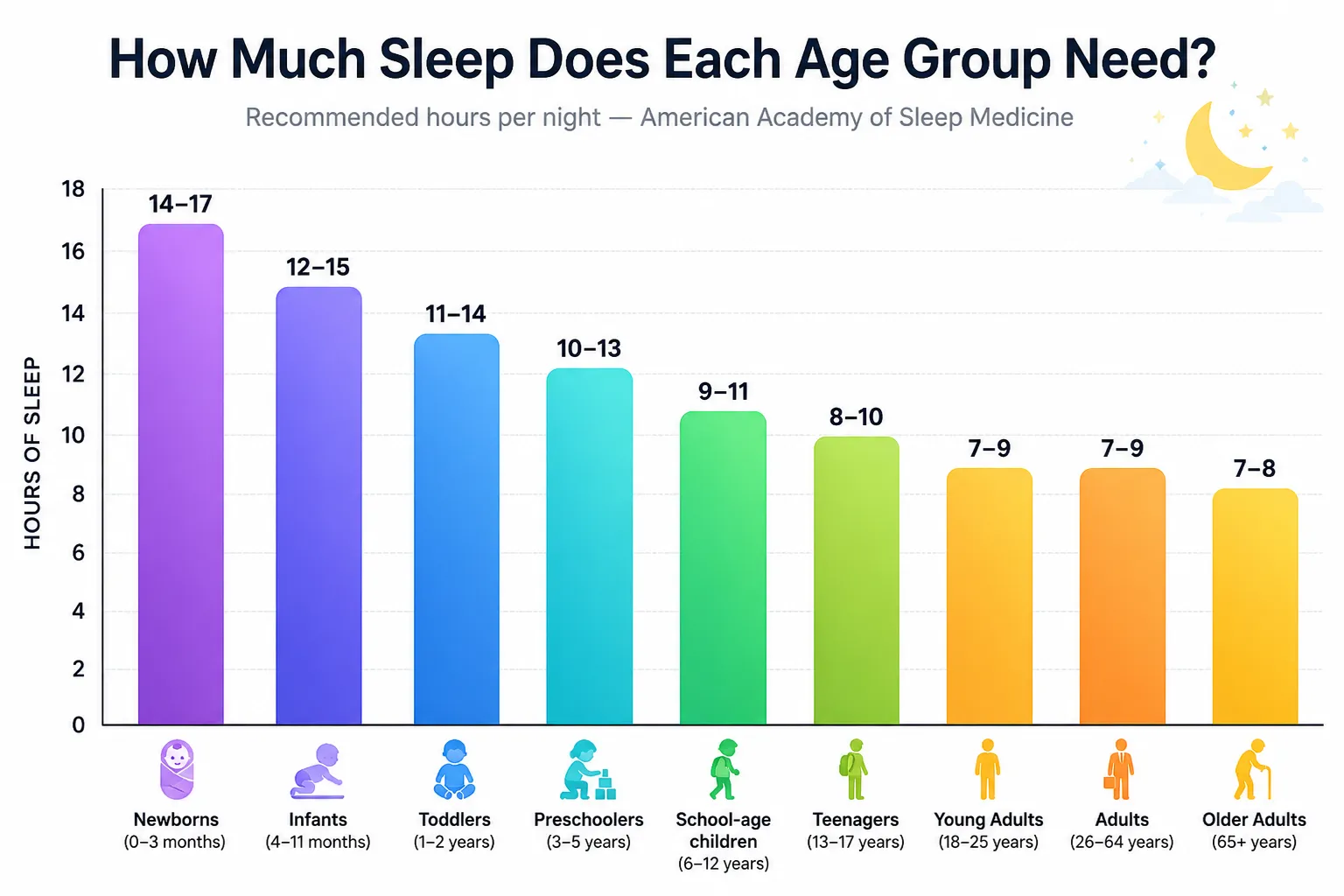
The American Academy of Sleep Medicine (AASM) and the Sleep Research Society jointly recommend that adults aged 18–60 sleep 7 or more hours per night on a regular basis to promote optimal health. The National Sleep Foundation is slightly more specific, recommending 7–9 hours for adults, with 7–8 hours for those over 65.
So the range is 7–9 hours. Not 8 exactly. A range — because humans aren’t identical.
Here’s what falls within that range in practical terms:
| Sleep Duration | Cycles Completed | How Most People Feel |
|---|---|---|
| 6 hours | 4 cycles | Functional. Accumulating debt quietly. |
| 7.5 hours | 5 cycles | The sweet spot for most adults. |
| 9 hours | 6 cycles | Ideal for recovery, illness, high physical demand. |
Notice something? 7.5 hours — not 8 — completes exactly 5 full sleep cycles of 90 minutes each. Eight hours, on the other hand, lands you 30 minutes into a sixth cycle. Wake up there and you'll feel worse than if you’d woken at 7.5. More on this shortly.
Why “Eight Hours” Became the Magic Number
The eight-hour myth has an interesting origin — and it has less to do with science than with industrialization.
Before electric lighting, humans typically slept in two separate blocks — a “first sleep” and a “second sleep” — with a quiet wakeful period in between. Historian Roger Ekirch documented this pattern extensively in his research on pre-industrial sleep. The consolidated eight-hour block we now consider normal is largely a product of the industrial revolution, artificial lighting, and the shift to fixed working hours.
The “eight hours work, eight hours rest, eight hours recreation” slogan was popularised by Welsh labour activist Robert Owen in the early 1800s — as a workers’ rights campaign, not a sleep prescription. It stuck. And somehow, “eight hours of rest” became “eight hours of sleep” in the cultural memory.
The actual science has always said: **a range, not a fixed number. ****
The Real Variables: What Actually Determines Your Sleep Need
Eight hours as a universal target overlooks several important factors.
1. Age
Sleep needs shift significantly across a lifetime.
| Age Group | Recommended Sleep | Key Notes |
|---|---|---|
| Teenagers (14–17) | 8–10 hours | Circadian rhythm shifts later; chronic under-sleeping is epidemic |
| Young adults (18–25) | 7–9 hours | Highest variability; lifestyle factors dominate |
| Adults (26–64) | 7–9 hours | The core adult range; individual variation within it |
| Older adults (65+) | 7–8 hours | Deep sleep naturally decreases; more night wakings are normal |
One important note on older adults: sleeping less as you age isn’t the same as needing less. Many older adults would sleep longer if their sleep architecture — the proportion of deep sleep to light sleep — hadn’t shifted. The body produces less slow-wave deep sleep with age, which means sleep becomes lighter and more fragmented even when the need remains.
2. Sleep Quality vs Sleep Quantity
Here’s the thing almost every “how much sleep do you need” article glosses over: six hours of high-quality sleep can be more restorative than eight hours of fragmented, disrupted sleep.
Sleep quality is determined by:
- How long it takes you to fall asleep (sleep onset latency — healthy range: 10–20 minutes)
- How many times you wake during the night
- How much time you spend in deep slow-wave sleep and REM sleep
- Whether your alarm wakes you mid-cycle or at a natural cycle boundary
A person with 90% sleep efficiency sleeping 7.5 hours is almost certainly better rested than someone sleeping 8.5 hours at 70% efficiency — even though the numbers say otherwise.
3. Sleep Cycles and Wake Timing
This is the piece most people have never been told — and it changes everything.
Your sleep runs in roughly 90-minute cycles, each containing four stages: light sleep (NREM 1), deeper sleep (NREM 2), deep slow-wave sleep (NREM 3), and REM sleep. You cycle through these 4–6 times per night.
Waking at the end of a cycle feels natural and refreshed. ** Waking mid-cycle — especially mid-deep sleep — produces sleep inertia: that thick, cotton-wool, who-am-I-and-what-year-is-it feeling that can last an hour.
This is why:
- 7.5 hours often feels better than 8 hours (5 complete cycles vs. 8 hours landing mid-cycle)
- 6 hours can feel better than 6.5 hours on a given night
- Your weekend lie-in sometimes makes Monday worse, not better
The number of hours matters. When those hours end matters just as much.

“Sleep is the best meditation.” — Dalai Lama
What Happens When You Don’t Get Enough
Let’s not be preachy about this. But let’s also not pretend it doesn’t matter.
Short-term sleep deprivation (1–3 nights of under-sleeping):
- Slower reaction times
- Reduced working memory
- Increased irritability and emotional reactivity
- Impaired decision-making (and, crucially, impaired ability to notice you’re impaired)
The last point deserves emphasis. Research from the University of Pennsylvania found that people restricted to 6 hours per night for two weeks performed as poorly on cognitive tests as people who had been awake for 48 hours straight — but they didn’t feel that bad. They had adapted to feeling impaired and lost the ability to accurately self-assess.
Sleep deprivation is uniquely good at hiding itself from the person experiencing it. You feel fine. You are not fine.
Chronic sleep deprivation (weeks to months of insufficient sleep):
- Elevated cortisol and disrupted stress response
- Metabolic effects — disrupted insulin regulation, increased appetite for high-calorie foods
- Immune suppression — people sleeping under 7 hours are significantly more likely to catch a cold when exposed to the virus
- Cardiovascular strain — consistent under-sleeping is associated with increased risk of hypertension and heart disease over time
- Mental health impact — bidirectional relationship with anxiety and depression
This is not a list designed to scare you into bed at 9 PM. It’s context. The body uses sleep to do an extraordinary amount of maintenance work — cellular repair, memory consolidation, emotional processing, immune function, hormonal regulation. Skimping on it isn’t neutral.
“The worst thing in the world is to try to sleep and not to.” — F. Scott Fitzgerald
The Myths Worth Busting
Myth 1: “I can function fine on 5 hours.”
Some people can. They carry a rare genetic variant — a mutation in the DEC2 gene — that allows genuine short sleep without impairment. Studies suggest this applies to **roughly 1–3% of the population. ****
If you’re reading this and thinking “that’s definitely me” — statistically, it almost certainly isn’t. Most people who believe they’re fine on 5 hours have adapted to feeling impaired. The research is fairly ruthless on this point.
Myth 2: “You can catch up on sleep at the weekend.”
The weekend lie-in feels like a solution. What it actually does is shift your circadian rhythm forward — making Sunday night harder to sleep and Monday morning worse. A 2019 study in Current Biology found that people attempting weekend sleep recovery showed worse metabolic outcomes than those who under-slept consistently without the recovery attempt. The irregularity causes its own damage.
Catching up on sleep is like making the minimum payment on a credit card. The balance goes down slightly. The debt is very much still there.
Myth 3: “More sleep is always better.”
Not quite. Consistently sleeping 10+ hours — when it’s not driven by illness, recovery, or genuine deprivation — is associated with its own set of health concerns. Oversleeping can be a symptom of depression, thyroid issues, or sleep disorders rather than a cause of problems. The goal isn’t maximum sleep. It’s optimal sleep — enough, well-timed, and efficient.
Myth 4: “If I feel tired, I need more sleep.”
Sometimes. But persistent daytime fatigue despite adequate sleep hours can also indicate:
- Low sleep efficiency (spending a lot of time in bed awake)
- Sleep apnoea (interrupting deep sleep repeatedly)
- Iron deficiency or thyroid issues
- Poor sleep timing (consistently waking mid-cycle)
- Depression or anxiety
“Sleep more” isn’t always the answer. "Sleep better" often is.
Signs You’re Getting the Right Amount of Sleep
Here’s a simple, honest checklist. No gadget required.
You’re probably getting enough sleep if:
- ✅ You wake up naturally close to your alarm time most mornings
- ✅ You feel alert within 30 minutes of waking — without needing caffeine to function
- ✅ You can sit in a quiet, warm room in the afternoon without fighting the urge to sleep
- ✅ Your mood is broadly stable and your patience is intact
- ✅ You don't feel significantly better after a lie-in (your body doesn't desperately need it)
You're probably not getting enough if:
- ❌ You rely on an alarm every morning and feel rough until coffee number two
- ❌ You fall asleep within minutes of lying down — every single night (this means your sleep pressure is unusually high)
- ❌ You feel noticeably better after sleeping in at weekends
- ❌ You regularly fall asleep unintentionally — on sofas, in cars, in meetings
- ❌ You're more irritable, less patient, and less like yourself than usual
The gold standard test used in sleep research is called the Multiple Sleep Latency Test (MSLT) — it measures how quickly you fall asleep in a quiet, darkened room during the day. Falling asleep in under 5 minutes is considered severe sleepiness. Falling asleep in 10–20 minutes is considered normal alertness.
Most of us can approximate this ourselves. If your head hits the pillow and you're out in two minutes flat every night — that's not a superpower. That's a sign.
How Much Sleep Do You Personally Need? A Practical Method
Forget the generalizations for a moment. Here’s how to find your number — the one that works for your biology, not the average.
Step 1: Use a sleep-free week. On holiday or during a period with no fixed alarm, go to bed when you feel naturally sleepy and wake without an alarm. After two to three nights of recovery from any existing sleep debt, your natural wake time will stabilize. The number of hours you’re sleeping then — consistently — is close to your genuine sleep need.
Most adults find this lands between 7.5 and 8.5 hours.
**Step 2: Work backward from your wake time in 90-minute blocks. **** Once you know roughly how many hours you need, use a sleep calculator to find the exact bedtime that lets you wake at the end of a complete cycle. Add 15 minutes for sleep onset.
Example: Wake up at 6:30 AM, 5 cycles needed:
6:30 am − 7.5 hours − 15 min = Bedtime: 10:45 pm
Step 3: Hold the schedule consistently. The circadian rhythm rewards consistency above almost everything else. Same bedtime, same wake time — including weekends — within 30–45 minutes. Within one to two weeks of consistent scheduling, most people find sleep quality improves noticeably even before total hours change.
The “Good Sleeper” Habits That Actually Work
There are approximately four thousand sleep hygiene articles on the internet. Most of them say the same twelve things. Here are the ones that are actually supported by research and make a measurable difference:
Fix your wake time first. This single habit anchors your circadian rhythm faster than anything else. Your bedtime can shift slightly night to night; your wake time should not.
Get morning light within 30–60 minutes of waking. Natural light — even on an overcast day — signals to your suprachiasmatic nucleus (the brain’s master clock) that the day has started. This anchors your melatonin timing for the coming night. Ten minutes outside in the morning is worth more than most sleep supplements.
Keep your bedroom cool. Your core body temperature needs to drop by about 1–2°C to initiate and maintain sleep. A room of around 16–19°C / 60–67°F supports this. A warm bedroom is one of the most underrated contributors to fragmented sleep.
Cut caffeine by early afternoon. Caffeine has a half-life of 5–6 hours. A 3 PM coffee still has half its caffeine active at 9 PM — enough to delay sleep onset and fragment the back half of your night without you realizing. Drinking coffee late and blaming insomnia on stress is one of the most common self-inflicted sleep problems.
Don’t go to bed until you’re actually sleepy. Tired and sleepy are different things. Tired is physical fatigue. Sleepy is the neurological readiness to sleep — eyes heavy, thoughts slowing, yawning. Going to bed tired but not sleepy means lying awake, which trains your brain to associate bed with wakefulness. Wait for sleepy.
Stop trying to force sleep. Sleep is the one thing that disappears the moment you pursue it too hard. It’s like trying to remember a word on the tip of your tongue — the harder you try, the further it retreats. Do something calm and unstimulating if you’re lying awake. Return when the sleepiness arrives naturally.
“Each night, when I go to sleep, I die. And the next morning, when I wake up, I am reborn.” — Mahatma Gandhi
The Bottom Line
How much sleep do adults need?
7–9 hours. Most adults find their personal sweet spot at 7.5 hours — five complete sleep cycles — because it completes cleanly without landing mid-cycle.
But the number is only part of the answer. When you sleep matters. How efficiently you sleep matters. Whether your alarm wakes you mid-cycle or at a natural endpoint matters.
The best sleep isn’t the longest sleep. It’s the right amount, at the right time, woken from at the right moment.
Everything else is just guessing — and you’ve been guessing long enough.
FAQ
How much sleep do adults actually need per night?↓
The American Academy of Sleep Medicine recommends 7 or more hours for adults aged 18–60. The National Sleep Foundation specifies 7–9 hours for most adults, with 7–8 hours for those over 65. The individual sweet spot varies — most people find 7.5 hours (5 complete 90-minute sleep cycles) feels best because it ends at a natural cycle boundary rather than mid-cycle.
Is 6 hours of sleep enough for adults?↓
For most adults, no — not consistently. Six hours falls below the recommended minimum and is associated with cognitive impairment, mood disruption, immune suppression, and metabolic effects over time. The complicating factor: people adapted to chronic short sleep often can’t accurately judge how impaired they are. A genuine genetic short sleeper (needing only 6 hours) exists — but represents roughly 1–3% of the population. Most people who believe they’re in this category aren’t.
Why do I still feel tired after 8 hours of sleep?↓
Most likely because 8 hours landed your alarm mid-cycle rather than at a natural cycle endpoint. Try 7.5 hours instead — it completes exactly 5 cycles, and most people find it feels significantly better despite being less time. Other causes include low sleep efficiency (spending significant time awake in bed), sleep apnoea, or underlying health issues worth checking if the fatigue persists despite good sleep habits.
Is it bad to sleep more than 9 hours regularly?↓
Consistently sleeping 10+ hours without a clear cause (illness, recovery from debt, intense physical training) is worth paying attention to. It can be a symptom of depression, thyroid problems, or sleep disorders rather than simply a sign of needing more rest. Occasional long sleep — during illness or genuine recovery — is normal and beneficial. Chronic oversleeping without explanation is worth mentioning to a doctor.
What happens to your body if you don’t sleep enough?↓
Short term: slower reactions, impaired memory and decision-making, emotional volatility, reduced immune function. Long term: elevated cortisol, disrupted insulin regulation, increased appetite (particularly for high-calorie foods), cardiovascular strain, and bidirectional worsening of anxiety and depression. The body uses sleep for cellular repair, memory consolidation, hormonal regulation, and immune maintenance — all of which suffer under chronic deprivation.
How do I know if I’m getting enough sleep?↓
The clearest signs: you wake naturally close to your alarm most mornings, feel alert within 30 minutes without caffeine, can sit quietly in the afternoon without fighting sleep, and don’t feel dramatically better after a weekend lie-in. If you’re reliant on an alarm, dependent on caffeine to function, and noticeably restored by sleeping in — you’re likely under-slept.
Does sleep need change with age?↓
Yes — in both quantity and quality. Teenagers need 8–10 hours; adults 7–9 hours; older adults 7–8 hours. Importantly, the decrease in older adults partly reflects changes in sleep architecture (less deep sleep produced naturally) rather than a reduced need. Many older adults would benefit from more sleep than they’re getting but find it harder to achieve as light sleep becomes more dominant and night wakings more frequent.
What is the best time to go to sleep?↓
The best bedtime is the one that lets your wake-up alarm land at the end of a complete 90-minute sleep cycle. Work backward from your wake-up time in 90-minute blocks and add 15 minutes for sleep onset. For most adults who wake between 6 and 7 AM, this puts the ideal bedtime somewhere between 10:30 PM and 11:30 PM for 5 cycles. Use the free sleep calculator at GetSleepCalculator.net to find yours precisely.
Find Your Exact Bedtime Tonight
Now you know the range — and why the range matters more than a single magic number. The next step is finding your number and the exact bedtime that makes waking up feel human again.
The free sleep calculator at GetSleepCalculator.net takes your wake-up time and works backward through complete 90-minute cycles to give you the optimal bedtimes for tonight. No guessing. No generic advice. Just the right time, calculated for your schedule.
→ Calculate your ideal bedtime at GetSleepCalculator.net — free, instant
Sources: Sleep duration recommendations from the American Academy of Sleep Medicine (AASM) and Sleep Research Society consensus statement, 2015. Sleep deprivation cognitive effects from Van Dongen et al., Sleep, 2003. Weekend sleep recovery and metabolic outcomes from Depner et al., Current Biology, 2019. Pre-industrial sleep patterns from Ekirch, At Day’s Close: Night in Times Past, 2005. Short sleep gene variant from He et al., Science, 2009. Sleep and immune function from Cohen et al., Sleep, 2009.
Calculate Your Perfect Sleep & Wake Times
Put this research into practice immediately. Our scientific calculators align your sleep with natural 90-minute REM cycles.
Related Articles
Sleep Efficiency Calculator: What Your Score Really Means
In bed for 8 hours but only sleeping 6? Calculate your sleep efficiency score, find out what's dragging it down, and fix it with simple, evidence-backed changes.
14 min read read →Sleep Debt Calculator: How Much Sleep Do You Actually Owe Yourself?
Running on 6 hours all week? Calculate your sleep debt and find out what it's actually costing you — plus the only evidence-backed way to genuinely pay it back.
14 min read read →Why You Need a Sleep Calculator (And Why Guessing Is Quietly Wrecking Your Sleep)
Still guessing your bedtime? A free sleep calculator tells you exactly when to sleep and wake up based on your cycles — no guesswork, no groggy mornings.
14 min read read →