Fact-Checked & Clinical Guidelines Aligned
Content rigorously reviewed to ensure alignment with clinical guidelines published by the National Sleep Foundation (NSF) and the American Academy of Sleep Medicine (AASM).
Why Does Gen Z Sleep So Late? The Science Behind a Generation That Can't Switch Off
Gen Z sleeps later than any generation before them — and it's not laziness. Here's the biology, the tech, the anxiety, and what Gen Z can actually do about it tonight.
“It is a common experience that a problem difficult at night is resolved in the morning after the committee of sleep has worked on it.” — John Steinbeck
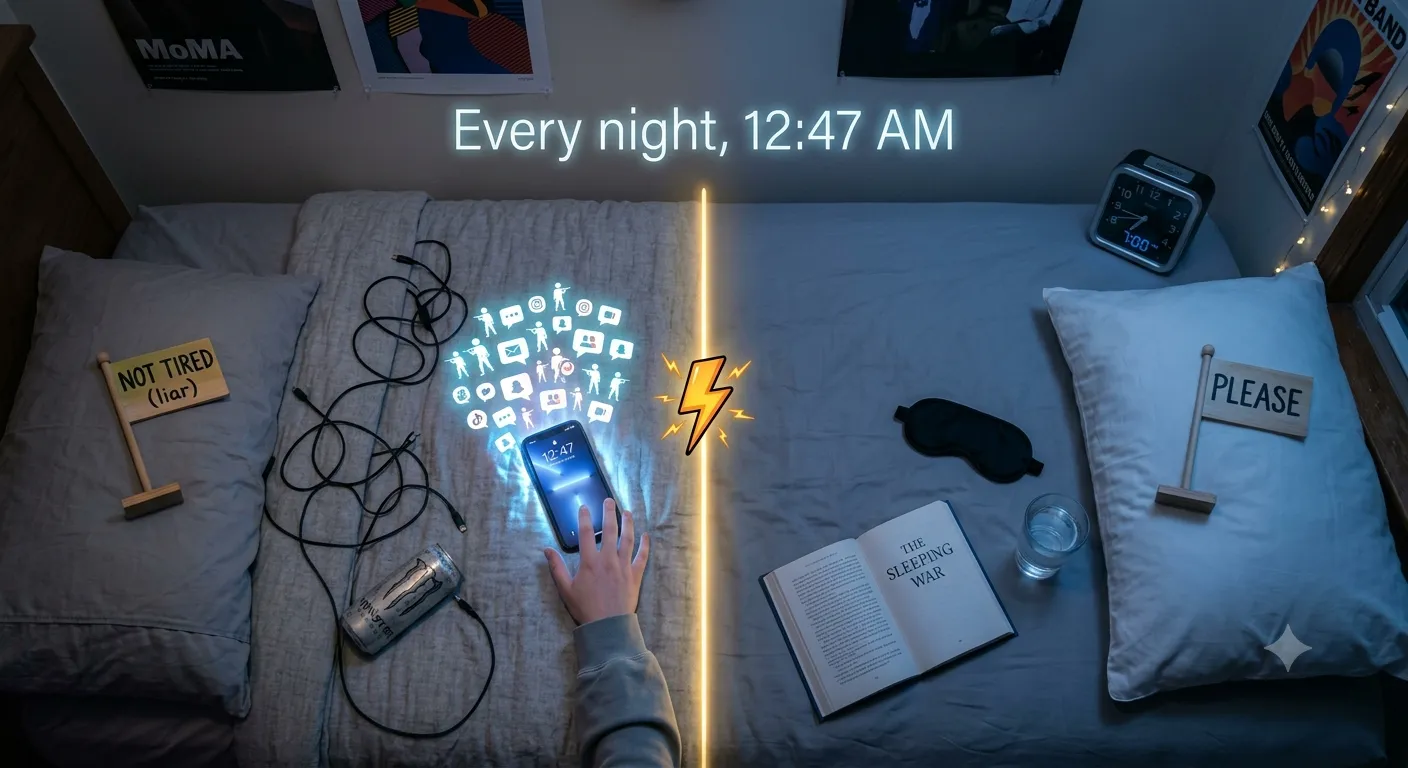
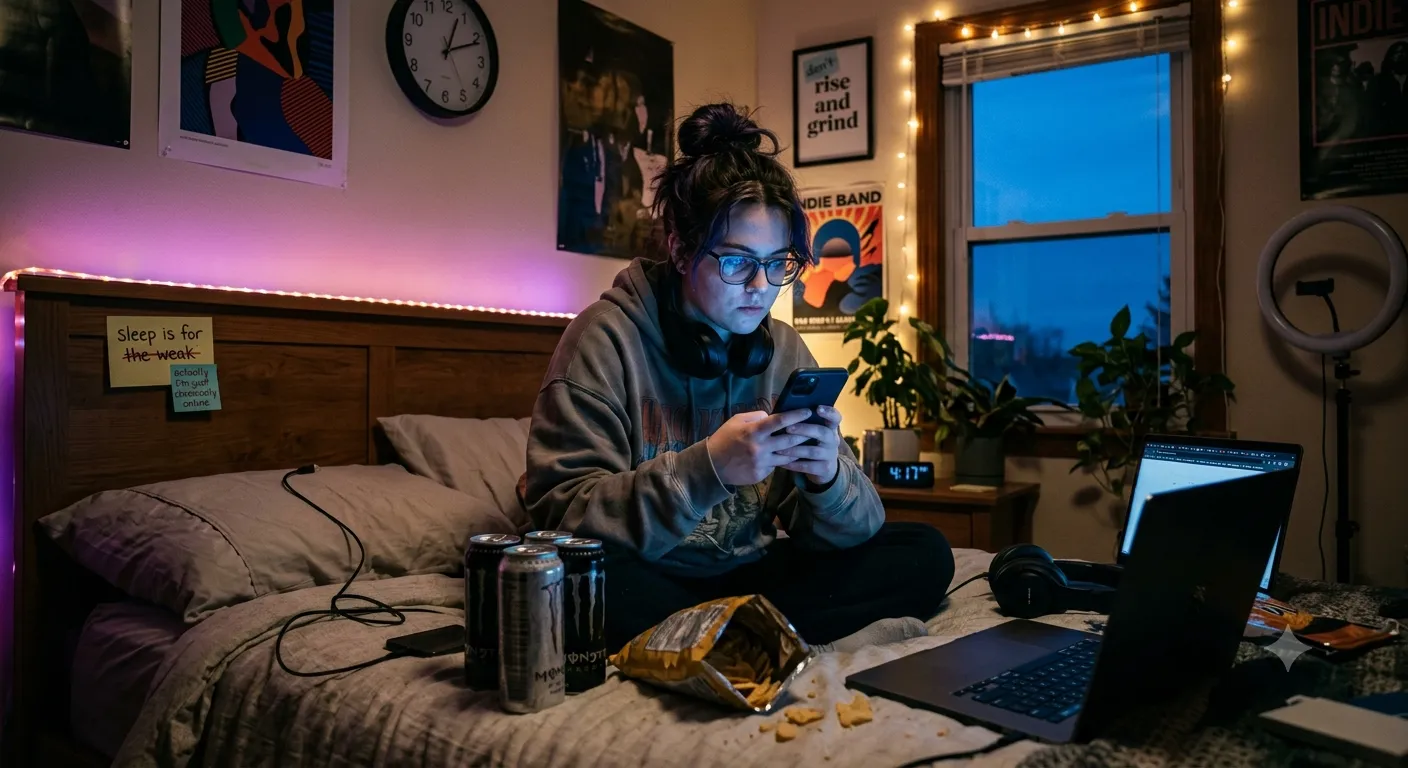
It’s 1:47 AM on a Tuesday.
A 19-year-old is lying in bed, phone propped on their chest, watching their fourth consecutive video about a topic they didn’t know existed two hours ago. They’re not even enjoying it anymore. They know they have a 9 AM lecture. They know they’ll feel terrible. They know they should stop.
They watch another video.
This scene is playing out in approximately fourteen million bedrooms simultaneously. And while it’s tempting to write it off as a generation-wide failure of self-control, the real explanation is considerably more interesting — and considerably more sympathetic — than that.
Gen Z sleeps later than any generation in recorded history. They go to bed later, wake up later when given the choice, report higher rates of insomnia, more anxiety-driven sleeplessness, and more daytime fatigue than Millennials, Gen X, or Boomers did at the same age.
And almost none of it is laziness.
It’s biology. It’s technology. It’s anxiety. It’s economics. It’s the specific and spectacular collision of all four happening to the same generation at the same time.
Here’s the full picture.
First: Who Is Gen Z, Exactly?
Generation Z refers to people born roughly between 1997 and 2012 — making them approximately 13 to 28 years old as of 2025. They are:
- The first generation to grow up with smartphones from childhood
- The most digitally connected generation in history
- The generation that experienced adolescence during a global pandemic
- The most anxious generation on record, by multiple measures
- The generation whose sleep researchers are now studying with increasing alarm
They are also, in fairness, the generation being blamed for things that are mostly not their fault. Their sleep isn’t late because they lack discipline. It’s late because they were handed a pocket-sized dopamine machine at age eleven and told to figure it out themselves.
Reason 1: Biology Did This First
Before we get to the phones — and we will get to the phones — it’s important to establish that late sleeping among teenagers and young adults is not a Gen Z invention. It is a biological phenomenon that predates Instagram by several centuries.
During puberty and into the early twenties, the human circadian rhythm — the internal 24-hour biological clock governed by the suprachiasmatic nucleus in the hypothalamus — undergoes a genuine, measurable phase shift. The body’s natural sleep timing moves later. The evening rise in melatonin — the hormone that signals it’s time to sleep — is delayed by 1 to 3 hours compared with that of both children and adults over 25.
This means a 17-year-old whose body clock genuinely wants to sleep at midnight is not being difficult or undisciplined. Their circadian rhythm is running on a later schedule than an adult’s — by biological design, not personal choice.
This phase shift has been documented across cultures and in populations with no access to artificial light or screens — which is the critical detail. The delayed circadian preference of adolescents and young adults exists independently of technology. Phones made it dramatically worse. They didn’t create it.
The sleep timing of Gen Z by the numbers:
Research from the National Sleep Foundation and multiple university studies shows:
| Age Group | Average Bedtime | Average Wake Time | Average Sleep Duration |
|---|---|---|---|
| Adults 35–50 | 10:45 pm | 6:30 am | 7.5 hours |
| Millennials (25–34) | 11:15 pm | 6:45 am | 7.0 hours |
| Gen Z (18–24) | 12:30 am | 8:00 am | 7.0 hours (when free) |
| Gen Z (school/work days) | 12:30 am | 6:30 am | 5.5–6 hours |
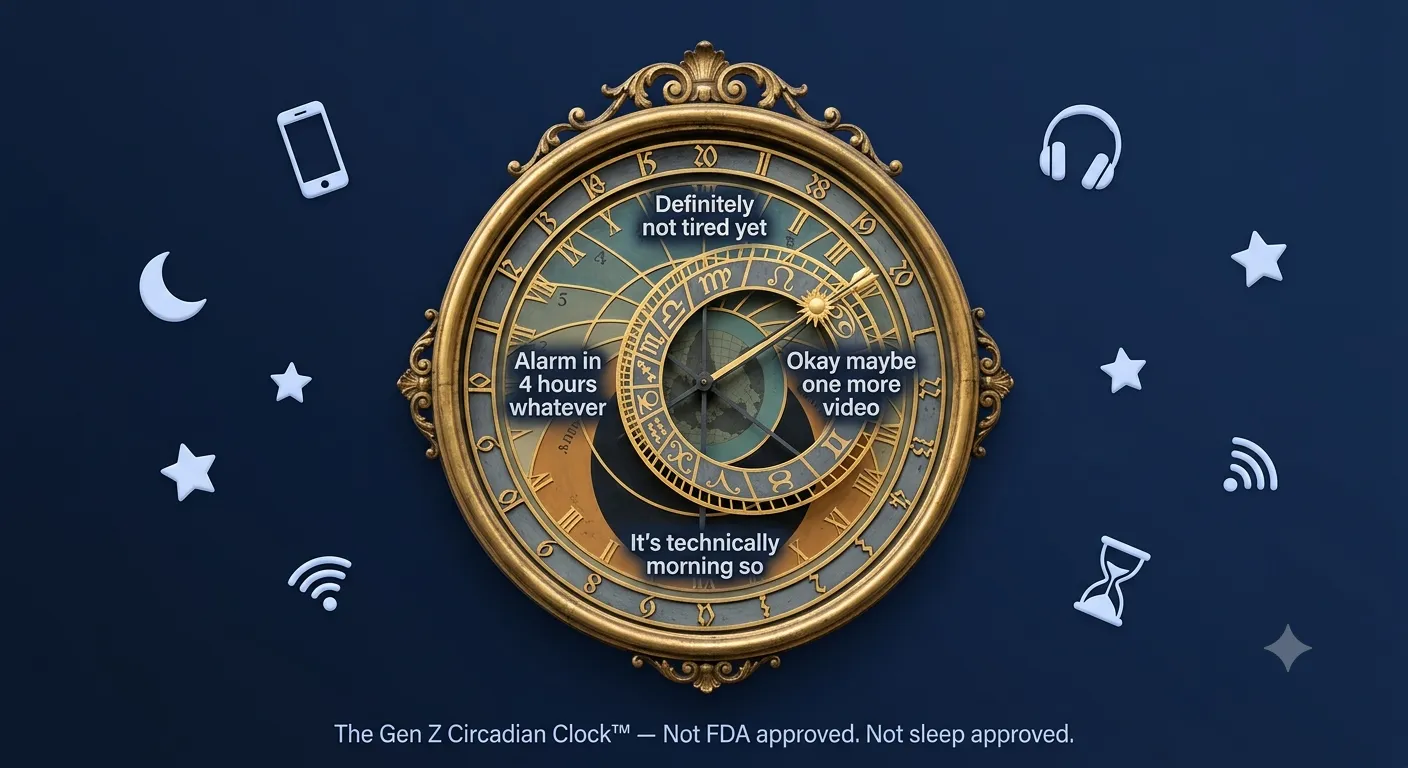
That last row is where the damage happens. Gen Z’s natural sleep timing is late. Society’s start times are early. The collision results in chronic, structural sleep deprivation among a generation whose brains are still developing.
Reason 2: Smartphones Are a Circadian Weapon
Now we get to the phones.
Gen Z is the first generation to have grown up with smartphones as a constant companion throughout adolescence — the exact developmental window during which the circadian phase shift is happening. The timing could not have been worse.
Smartphones damage Gen Z sleep through three distinct mechanisms. Each one is damaging on its own. Together, they are formidable.
Mechanism 1: Blue Light Suppression of Melatonin
Smartphone screens emit blue-wavelength light — the same wavelength that signals to the brain’s circadian clock that it is daytime. Evening blue light exposure suppresses melatonin production and delays its onset, effectively tricking the brain into thinking the sun hasn’t set yet.
Research from Harvard Medical School found that blue light suppresses melatonin for roughly twice as long as green light and can shift the circadian rhythm by up to three hours. For a Gen Z teenager whose circadian rhythm is already running late, adding two to three hours of blue light exposure before bed pushes their natural sleep time from midnight to 2 or 3 AM — while their school alarm is still set for 6:30.
Night mode and blue light glasses help at the margins. They do not solve the underlying problem — which brings us to mechanism two.
Mechanism 2: Algorithmic Engagement Is Designed to Prevent Sleep
This one doesn’t get enough attention.
Social media platforms — TikTok, Instagram, YouTube, Twitter/X — are built on engagement algorithms that are optimised for one thing: keeping you on the platform as long as possible. These algorithms are extraordinarily good at their job. They learn your preferences faster than you do, serve content calibrated precisely to your interests, and create a variable reward loop — the same psychological mechanism that makes gambling addictive — where you keep scrolling because the next video might be the interesting one.
This is not a coincidence or a side effect. The product is working as designed. The business model of social media is attention. Your sleep is not their concern.
The algorithm doesn’t know what time it is and doesn’t care. It just knows you’re still watching. And it will keep serving content until you physically put the phone down — which, it turns out, is one of the hardest things to ask of a human brain wired for novelty and social connection.
Gen Z didn’t develop weak willpower. They were handed the most sophisticated attention-capture technology ever built at an age when the prefrontal cortex — the part of the brain responsible for impulse control and long-term decision-making — was still years away from full development. Asking a 14-year-old to put down TikTok at 10 PM is asking their not-yet-fully-developed impulse control to override a billion-dollar engineering effort. The odds were never in their favour.
Mechanism 3: Social Media Creates Anxiety That Prevents Sleep
Even when Gen Z puts the phone down, sleep doesn’t always come.
Social media creates a specific type of anxiety that is particularly incompatible with sleep — a constant low-level background hum of social comparison, FOMO (fear of missing out), awareness of global news and crises, and the ambient pressure of maintaining a digital identity.
Cortisol — the stress hormone — needs to be low for sleep to initiate. Anxiety keeps cortisol elevated. And the content Gen Z consumes before bed — news, social comparison, comment sections, political discourse — is reliably cortisol-raising.
The phone goes away. The thoughts don’t. The anxiety about the thing they saw on the phone, the comment they got, the story they read — these follow them into the dark and keep them awake long after the screen is off.
Reason 3: Anxiety Is a Gen Z Epidemic — and Anxiety Destroys Sleep
Gen Z is the most anxious generation on record. This is not a stereotype. It is a consistent finding across multiple large-scale mental health surveys.
The American Psychological Association’s annual Stress in America survey has found Gen Z reporting higher levels of stress, anxiety, and depression than any previous generation at the same age. The causes are multiple and real:
- Climate anxiety: Gen Z is the first generation to grow up with a clear scientific consensus on climate change and a lived experience of its accelerating effects. Many genuinely believe they are inheriting a damaged world.
- Economic anxiety: Housing costs, student debt, job market instability, and the collapse of the “work hard and you’ll be fine” social contract have created financial anxiety that permeates this generation.
- Social anxiety amplified by social media: The always-on nature of social media means social dynamics that previous generations experienced only at school now follow Gen Z home, to bed, and into every waking moment.
- Post-pandemic effects: Gen Z experienced the pandemic during critical developmental years — adolescence and early adulthood. The isolation, disruption, and collective trauma of 2020–2022 left measurable marks on mental health across the generation.
What anxiety does to sleep:
Anxiety activates the sympathetic nervous system — the fight-or-flight response. This elevates cortisol, raises heart rate, increases core body temperature, and produces hyperarousal — the exact opposite of the neurological state required for sleep onset. People with anxiety don’t just struggle to fall asleep; they often experience the specific cruelty of feeling exhausted but unable to switch off, lying awake with racing thoughts while desperately wanting to sleep.
This is called psychophysiological insomnia — insomnia driven by the psychological arousal that comes from worrying about not sleeping. The sleep anxiety creates the sleeplessness it fears—a perfect, vicious loop.
Reason 4: School and Work Start Times Are Set for a Different Biology
Here is an institutional failure that receives nowhere near enough attention.
Most high schools and universities start between 7:30 and 9:00 AM. Most workplaces expect employees to be present by 8:00 or 9:00 AM. These times were set for an adult population whose circadian rhythm is anchored earlier than that of teenagers and young adults.
For a Gen Z student whose biological sleep timing puts their natural wake time at 8:30 or 9:00 AM, a 6:30 AM alarm for an 8:00 AM school start isn’t just inconvenient. It is chronobiologically equivalent to asking a standard adult to wake up at 4:00 AM every day.
Consistently. Five days a week. For years.
The American Academy of Paediatrics has recommended that middle and high schools start no earlier than 8:30 AM since 2014, citing evidence of improved academic performance and mental health, and reduced accident rates. Implementation has been painfully slow. The structural mismatch between adolescent biology and institutional timing remains one of the most thoroughly documented and thoroughly ignored problems in public health.
The result is social jetlag — the term sleep researchers use for the misalignment between your biological clock and your social schedule. Gen Z experiences social jetlag structurally, chronically, as a feature of daily life rather than the occasional consequence of a late night. And social jetlag carries the same costs as any other form of sleep deprivation: cognitive impairment, mood disruption, metabolic effects, immune suppression.
Reason 5: The Pandemic Broke the Body Clock — and It Hasn’t Fully Recovered
COVID-19 did something unprecedented to global sleep patterns — and Gen Z was disproportionately affected.
During lockdowns, external schedule anchors disappeared: no commute, no fixed school start time, no social obligation to be anywhere at a particular hour. Without these external zeitgebers (the German word sleep researchers use for “time givers” — the environmental cues that anchor the circadian rhythm), sleep timing drifted.
Studies conducted during the pandemic found that people’s sleep timing shifted later by an average of 30–50 minutes globally. But in younger people — those with already-delayed circadian rhythms — the drift was larger and faster. Without the forcing function of a 7:30 AM school start, many teenagers and young adults settled into sleep schedules that reflected their actual biological preferences for the first time — and those schedules were late.
Post-pandemic, the external anchors returned. The circadian rhythms did not snap back with the same speed. Many Gen Z individuals entered 2022 and beyond with sleep timing that had drifted significantly later than pre-pandemic, now being forced to conform to early start times again. The result was a generation already prone to late sleeping, carrying pandemic-era circadian drift, being asked to function on early schedules they hadn’t kept for two years.
Reason 6: Gen Z Has Redefined What Nighttime Is For
There is a cultural dimension to Gen Z sleep timing that goes beyond biology and technology.
For previous generations, nighttime was largely the end of the day — shops closed, entertainment options were limited, social interaction required physical presence. For Gen Z, nighttime is the most private and autonomous part of their day.
It’s when parents are asleep and can’t monitor the phone. When the world is quieter, and social media feeds slow down. When the specific kind of creative, introspective thinking that many Gen Z individuals report preferring emerges. When online friendships — many of which span time zones — are most active.
Late nights aren’t purely a failure to sleep for many Gen Z individuals. They’re also the only quiet, autonomous time available. The bedroom at midnight is genuinely where a significant part of Gen Z’s inner and social life happens.
This doesn’t make the sleep deprivation less damaging. But it does mean that “just go to bed earlier” is not only an incomplete prescription — it also misunderstands what staying up late sometimes provides.
What the Sleep Deprivation Is Actually Costing Gen Z
This isn’t abstract. The documented effects of chronic sleep deprivation in adolescents and young adults are severe:
Cognitive effects:
- Impaired working memory and learning consolidation — critical during the educational years
- Slower reaction times and reduced attention span
- Poorer decision-making — particularly relevant given that adolescence is a period of significant life decisions
Mental health effects:
- Bidirectional relationship with anxiety and depression — poor sleep worsens both, and both worsen sleep
- Increased emotional reactivity and reduced emotional regulation
- Higher rates of suicidal ideation in chronically sleep-deprived adolescents — one of the most alarming findings in adolescent sleep research
Physical effects:
- Disrupted growth hormone release (which happens primarily during slow-wave sleep)
- Metabolic effects — disrupted insulin regulation, increased appetite for high-calorie foods
- Immune suppression
Academic and performance effects:
- Lower grades, reduced academic engagement, higher dropout rates
- Impaired athletic performance — recovery from training happens during sleep
The generation often labelled as lazy or unmotivated is, in significant part, a generation running on chronically insufficient sleep trying to function in a world that started two hours before their biology was ready.
What Gen Z Can Actually Do About It
Not “put your phone down at 9 PM.” That advice is technically correct and practically useless without a framework. Here’s what actually works:
1. Fix the Wake Time First — Even Before the Bedtime
The single most powerful intervention for a drifted circadian rhythm is a consistent wake time. Not an earlier bedtime — a fixed wake time. Every day. Including weekends. Within 30 minutes of the same time.
This is hard. It is also the most evidence-backed circadian intervention available without a prescription. The wake time anchors the circadian rhythm. Once the wake time is fixed and held consistently, the sleep pressure (the build-up of adenosine that makes you sleepy) starts arriving at a more predictable and earlier hour — making an earlier bedtime feel natural rather than forced.
Start with a realistic wake time. Not 6 AM if you’ve been waking at 10. Try 8:30. Hold it for two weeks. Then gradually pull it earlier if needed.
2. Get Bright Light in the First Hour of Waking
Morning light — natural daylight, even on an overcast day — is the most powerful circadian anchor available. It signals to the suprachiasmatic nucleus that the day has started, which anchors melatonin timing for the coming night.
Ten to fifteen minutes outside within an hour of waking. No sunglasses. This one habit, done consistently, will shift your circadian rhythm earlier faster than almost anything else — including melatonin supplements.
3. Create a Hard Cutoff for Algorithmic Content
Not screens entirely — algorithmic content specifically. TikTok, Instagram Reels, YouTube autoplay, Twitter/X feeds. These are the engagement-optimised formats that are most effective at extending time online past intended limits.
One hour before bed: switch from algorithmic content to intentional content. A specific show you’re watching on purpose. A podcast episode you chose. A book. A conversation. Anything where you — not an algorithm — decided what comes next.
This is more achievable than “no screens” and more effective than “blue light glasses.” The blue light is a problem. The algorithmic engagement is a bigger one.
4. Address the Anxiety Directly
For Gen Z specifically — where anxiety is frequently the engine keeping sleep at bay even after the phone is down — sleep interventions alone are often insufficient. The anxiety needs addressing.
Practical starting points:
- Journalling before bed: Write down everything currently living in your head — worries, tasks, thoughts. Externalising them reduces their cognitive load at 2 AM.
- Set a “worry time”: Schedule 15–20 minutes earlier in the evening to actively think about your worries. Write them down. Then when they arrive at midnight, you can legitimately tell your brain “we already dealt with that.”
- Limit news and high-stress content in the evening: Not because ignorance is bliss, but because the problems of the world are not more solvable at midnight, and the cortisol from engaging with them costs you sleep that would make you more capable of engaging with them tomorrow.
For persistent anxiety significantly impacting sleep, CBT-I (cognitive behavioural therapy for insomnia) and CBT for anxiety are the evidence-based treatments. Both are available online now — which, for once, is technology working in Gen Z’s favour.
5. Use a Sleep Calculator to Find Your Actual Bedtime
Given Gen Z’s later circadian timing, the standard “be in bed by 10:30 PM” advice is often misaligned with their biology. This doesn’t mean late sleeping is fine indefinitely — but it does mean the bedtime target needs to be realistic and calculated, not arbitrary.
The sleep calculator works backwards from your required wake time in 90-minute sleep cycles — adding 15 minutes for sleep onset — to give you the specific bedtimes that will let you wake at the end of a complete cycle rather than mid-deep sleep.
For a Gen Z student waking at 7:00 AM for a 9 AM class:
- 5 cycles (7.5 hrs): Bedtime → 11:15 pm
- 4 cycles (6 hrs): Bedtime → 12:45 am
For someone waking at 8:30 AM:
- 5 cycles (7.5 hrs): Bedtime → 12:45 am
- 6 cycles (9 hrs): Bedtime → 11:15 pm
These are real, achievable targets for Gen Z sleep timing — not the “be in bed by 10” advice that feels biologically impossible and gets ignored.
The Myth Worth Busting: “Gen Z Is Just Lazy”
This framing needs to be retired.
A generation experiencing a documented biological circadian phase shift, raised on engagement-optimised technology designed by the world’s most sophisticated engineers to capture and hold attention, navigating historically high levels of anxiety and economic precarity, subjected to school start times that contradict their chronobiology — this generation is not lazy.
It is under-slept. Structurally. Systematically. Through a combination of biology, technology, institutional inertia, and cultural forces beyond its control.
The solution isn’t simply to tell Gen Z to try harder. It’s to understand the actual mechanisms driving their sleep timing and address them specifically — which is what this post has tried to do.
Lazy would be not trying. Gen Z is trying. They’re just trying while running on five and a half hours of sleep, which makes everything harder, including the trying.
FAQ
Why does Gen Z sleep so late?↓
Multiple overlapping reasons: a genuine biological circadian phase shift during adolescence and young adulthood that delays natural sleep timing by one to three hours; smartphone use that suppresses melatonin through blue light and delays sleep through algorithmic engagement; historically high anxiety levels that keep cortisol elevated past the point where sleep can initiate; school and work start times misaligned with their biology; and pandemic-era circadian drift that many haven’t fully recovered from. It is not primarily a discipline or motivation problem.
Is it bad for Gen Z to sleep late?↓
The late sleep timing itself is less damaging than the sleep deprivation it produces. When Gen Z can sleep late and wake late — aligning their schedule with their circadian preference — their sleep quality is often fine. The damage happens when late sleep timing collides with early start times, producing chronic sleep deprivation of five to six hours per night. That level of sleep debt has measurable effects on cognition, mental health, immune function, and long-term health outcomes.
How much sleep does Gen Z actually need?↓
Teenagers (13–17) need 8–10 hours per night. Young adults (18–25) need 7–9 hours of sleep. Most Gen Z individuals are getting significantly less than this on school and work days — often five to six hours — due to the mismatch between their late sleep timing and early social obligations. The quantity needed hasn’t changed. The ability to get it has been compromised by both biology and environment.
Does social media actually cause Gen Z to sleep less?↓
Yes — through three mechanisms. First, blue light from screens suppresses melatonin and delays sleep onset. Second, algorithmic content is designed to maximise engagement time, making it structurally difficult to stop scrolling at a planned time. Third, social media content — social comparison, news, comment sections — elevates cortisol and creates anxiety that persists after the phone is put down, delaying sleep further. Each mechanism is damaging independently. Together they are the most significant environmental driver of Gen Z sleep delay.
What time should Gen Z go to sleep?↓
It depends on their wake time and how many sleep cycles they need. Using a sleep calculator and working backwards from their required wake time in 90-minute blocks gives the most precise answer. For most Gen Z individuals waking between 7 and 8:30 AM, a bedtime between 11:15 PM and 1:00 AM targets five complete sleep cycles (7.5 hours). Earlier is better for long-term circadian health — but a realistic late bedtime calculated to a cycle endpoint is far better than an arbitrary early bedtime that produces lying awake for an hour before sleep arrives.
Can Gen Z fix their sleep schedule?↓
Yes — but gradually and realistically. The most effective interventions are: fixing a consistent wake time (even before fixing the bedtime), getting morning daylight within an hour of waking, replacing algorithmic screen content with intentional content in the hour before bed, and directly addressing the anxiety that keeps many Gen Z individuals awake after the phone is down. Expecting an immediate shift from a 2 AM bedtime to 10:30 PM is unrealistic and usually fails. Pulling the schedule earlier by 15–20 minutes every few days, while holding the wake time consistent, is how circadian rhythms actually shift.
Is Gen Z’s late sleep timing permanent?↓
No. The circadian phase shift of adolescence and young adulthood is temporary. Research consistently shows that sleep timing naturally shifts earlier in the mid-to-late twenties as the biological phase shift reverses. Gen Z individuals who are 25+ typically find themselves genuinely wanting to sleep earlier than they did at 17 or 20 — not because of discipline, but because their biology has changed. The challenge is managing the sleep deprivation during the years when the mismatch is most severe.
Did the pandemic make Gen Z sleep worse?↓
Yes — significantly. During lockdowns, the removal of external schedule anchors (school start times, commutes, social obligations) allowed sleep timing to drift later for most people, but particularly for younger people with already-delayed circadian rhythms. Studies found sleep timing shifted later by an average of 30–50 minutes globally during the pandemic, with larger shifts in adolescents and young adults. Post-pandemic return to early schedules created a collision between drifted circadian timing and unchanged institutional start times — compounding the sleep problems Gen Z was already experiencing.
The Bottom Line
Gen Z sleeps late because their biology runs on a later schedule. After all, technology was designed to keep them engaged past the point of sleep. After all, anxiety is running at epidemic levels through their generation, and the world’s schedule was set for people whose body clocks are different from theirs.
That’s not an excuse. It’s a diagnosis. And diagnoses are useful because they point toward actual solutions — which are more specific and more achievable than “just go to bed earlier and put your phone down.”
Fix the wake time. Get morning light. Replace the algorithm with intention in the last hour before bed. Address the anxiety. Calculate the actual bedtime that works for your schedule — not the one that sounds reasonable to someone whose circadian rhythm peaks three hours before yours.
The sleep is possible. It just needs to be built around the biology that actually exists, not the one that would be more convenient.
Sources: Circadian phase delay in adolescents from Carskadon et al., Sleep, 1998. Gen Z anxiety data from American Psychological Association Stress in America Survey, 2023. Blue light and melatonin suppression from Tosini et al., Molecular Vision, 2016. Social jetlag from Roenneberg et al., Current Biology, 2012. School start times and adolescent sleep: American Academy of Paediatrics policy statement, 2014. Pandemic sleep timing changes from Blume et al., Current Biology, 2020. Sleep deprivation and adolescent mental health from Cheng et al., Sleep Medicine Reviews, 2020. Recommended sleep durations from the American Academy of Sleep Medicine (AASM).
Calculate Your Perfect Sleep & Wake Times
Put this research into practice immediately. Our scientific calculators align your sleep with natural 90-minute REM cycles.
Related Articles
Sleep Efficiency Calculator: What Your Score Really Means
In bed for 8 hours but only sleeping 6? Calculate your sleep efficiency score, find out what's dragging it down, and fix it with simple, evidence-backed changes.
14 min read read →Sleep Debt Calculator: How Much Sleep Do You Actually Owe Yourself?
Running on 6 hours all week? Calculate your sleep debt and find out what it's actually costing you — plus the only evidence-backed way to genuinely pay it back.
14 min read read →Why You Need a Sleep Calculator (And Why Guessing Is Quietly Wrecking Your Sleep)
Still guessing your bedtime? A free sleep calculator tells you exactly when to sleep and wake up based on your cycles — no guesswork, no groggy mornings.
14 min read read →