Fact-Checked & Clinical Guidelines Aligned
Content rigorously reviewed to ensure alignment with clinical guidelines published by the National Sleep Foundation (NSF) and the American Academy of Sleep Medicine (AASM).
Is 3 Hours of Sleep Enough?
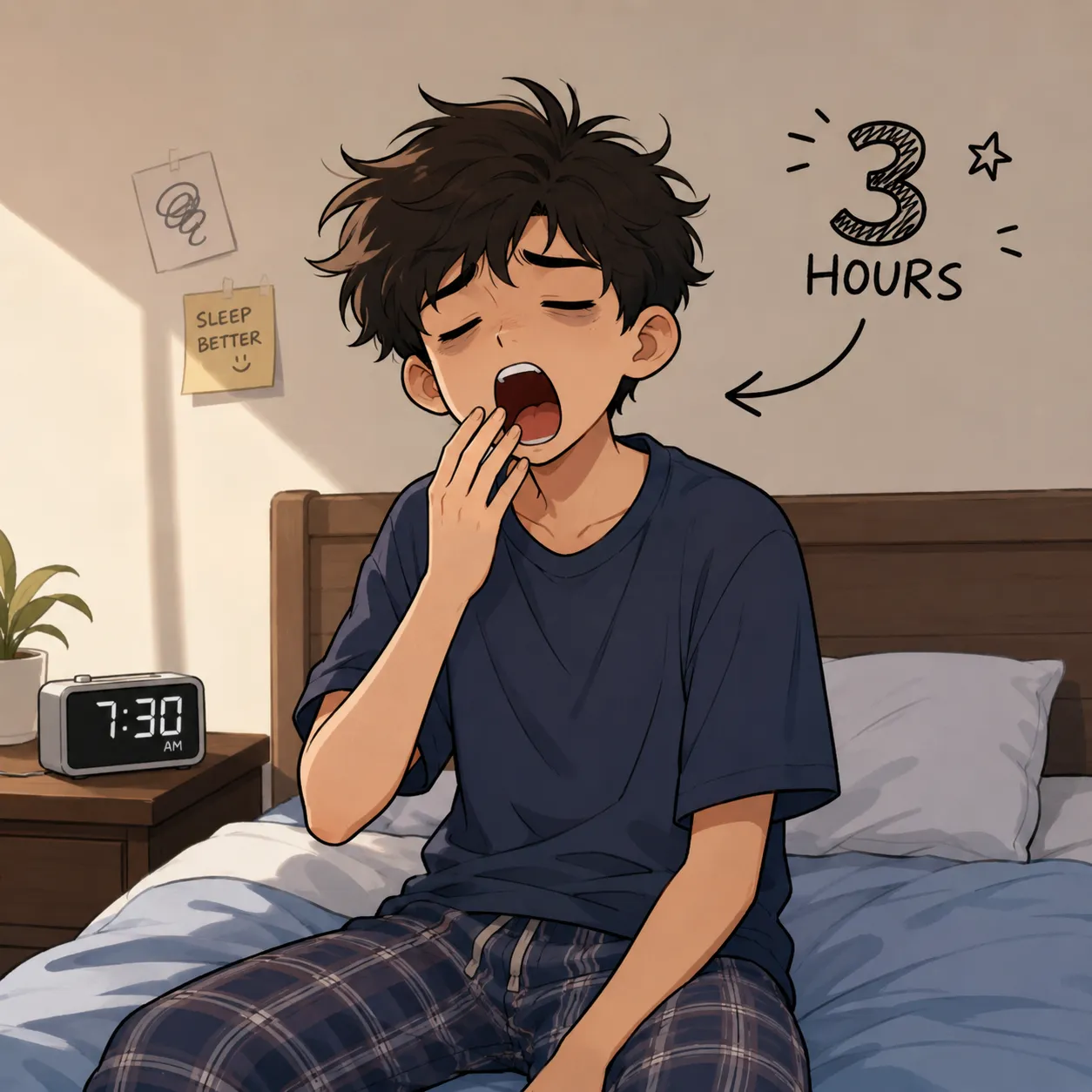
Is 3 hours of sleep enough to function? The short answer is no — but the full answer is more interesting. Here's what actually happens to your brain and body on 3 hours, and what to do tonight.
Is 3 Hours of Sleep Enough? The Honest, Science-Backed Answer

"A ruffled mind makes a restless pillow." — Charlotte Brontë
It's 3 am. You have to be up at 6 am. The maths is already done and you don't like it.
Maybe you were out late. Maybe work ran over. Maybe you made a series of increasingly questionable decisions that led you to this exact moment, staring at the ceiling with three hours between you and the alarm. And somewhere in your tired brain, a hopeful voice asks: is three hours enough to at least take the edge off?
The answer — honest, science-backed, and delivered without judgement — is: no. But it's not nothing.
Three hours of sleep is not enough for any adult to function at full capacity. It is not enough to avoid cognitive impairment. It is not enough to protect your mood, your immune system, your metabolism, or your long-term health. The science on this is not ambiguous.
But three hours is also better than zero. And knowing exactly what three hours does and doesn't do — and what to do when that's all you have — is more useful than a simple "you should sleep more."
Here's the full picture.
What Actually Happens on 3 Hours of Sleep
Your sleep runs in 90-minute cycles, each containing four stages: light sleep (NREM 1), deeper sleep (NREM 2), slow-wave deep sleep (NREM 3), and REM sleep. A full night of adequate sleep completes five of these cycles — approximately 7.5 hours.
Three hours of sleep completes exactly two full cycles. Here's what that means in practice:
What you get in 3 hours:
- Two passes through slow-wave deep sleep (NREM 3) — the most physically restorative stage
- Two passes through REM sleep — critical for emotional processing and memory
- Some immune system maintenance
- Some physical restoration
What you don't get:
- Cycles 3, 4, and 5 — which are progressively richer in REM sleep
- The full memory consolidation that happens across a complete night
- The hormonal regulation that adequate sleep provides
- The cognitive restoration that only compounds across full sleep duration
The cruel irony of three hours: you get the physical restoration of early cycles but miss the cognitive and emotional restoration of later ones. Your muscles might feel okay. Your brain almost certainly won't.
What 3 Hours Does to Your Brain
This is where the science gets genuinely alarming — not to frighten, but because the impairment is real and worth understanding.
Cognitive Performance
Research from the University of Pennsylvania — the same study that found two weeks of 6-hour nights produced impairment equivalent to 48 hours without sleep — established clear dose-response relationships between sleep duration and cognitive function.
Three hours of sleep produces impairment on:
- Sustained attention — the ability to stay focused on a task over time
- Working memory — holding and manipulating information in the short term
- Processing speed — how quickly the brain interprets and responds to information
- Decision-making — particularly the ability to assess risk accurately
- Reaction time — significantly impaired after even one night of short sleep
Here's the part that matters most: the impairment is real even when it doesn't feel real. Research consistently shows that sleep-deprived people underestimate their own impairment. After a night of three hours, you will feel more capable than you are. Your brain loses the ability to accurately judge how badly it's functioning — which is precisely when the consequences of that dysfunction are most dangerous.
Driving on three hours of sleep produces impairment comparable to driving over the legal alcohol limit in many jurisdictions. This is not a metaphor. It is a direct comparison from road safety research.
Memory and Learning
Memory consolidation — the process by which the brain transfers learning from short-term to long-term storage — happens primarily during sleep, particularly during the REM sleep that dominates later cycles.
Three hours cuts off the REM-rich cycles that consolidate the most learning. Whatever you studied, learned, or processed yesterday is less effectively stored after three hours of sleep than it would be after seven. Staying up late to prepare for something and sleeping only three hours is not just unpleasant — it actively undermines the preparation.
Emotional Regulation
The amygdala — the brain's emotional processing centre — becomes significantly more reactive under sleep deprivation. Research from UC Berkeley showed that the amygdala's response to negative stimuli increased by up to 60% after sleep deprivation, with reduced connectivity to the prefrontal cortex (the rational, regulatory part of the brain).
In plain terms: on three hours of sleep, everything feels more intense. Frustration feels like anger. Worry feels like crisis. Minor irritants feel significant. This isn't weakness — it's a predictable neurological consequence of insufficient sleep, operating independently of your intention or character.
What 3 Hours Does to Your Body
The effects aren't only cognitive.
Immune function: A landmark study published in Sleep journal found that people sleeping under 7 hours were nearly three times more likely to develop a cold when exposed to the rhinovirus than those sleeping 8+ hours. Three hours represents severe acute sleep restriction — immune suppression is immediate and measurable.
Cortisol and stress response: Sleep deprivation elevates cortisol — the stress hormone. Even one night of severely restricted sleep produces elevated cortisol the following day, increasing baseline stress reactivity and contributing to the emotional volatility described above.
Appetite hormones: Sleep deprivation disrupts ghrelin (hunger hormone — increases) and leptin (satiety hormone — decreases). After three hours of sleep, you are biologically primed to eat more, particularly high-calorie, high-carbohydrate foods. This isn't a coincidence — it's your body attempting to find energy from food to compensate for what it didn't get from sleep.
Growth hormone: The majority of growth hormone release happens during slow-wave deep sleep in the early cycles — which three hours does capture. This is one of the reasons three hours isn't nothing: some physical restoration does happen. But the hormonal environment of the full night is not replicated.
Is There Anyone for Whom 3 Hours Is Enough?
This question gets asked a lot. The honest answer is: almost certainly not you.
There is a documented genetic variant — a mutation in the DEC2 gene (and more recently identified variants in ADRB1 and other genes) — that allows a small number of people to genuinely function on 4–6 hours of sleep without impairment. Researchers call these people short sleepers.
True short sleepers:
- Wake naturally after 4–6 hours feeling fully rested
- Show no cognitive impairment on objective testing despite short sleep
- Don't accumulate sleep debt over time
- Represent approximately 1–3% of the population
Three hours is below the threshold even for documented short sleepers. No published research has identified a population that genuinely thrives on three hours of sleep without impairment.
If you believe you're fine on three hours: the research suggests you're not, and that you've adapted to the impaired state so thoroughly that you can no longer detect it. This is one of the most consistently replicated findings in sleep science — chronic sleep restriction impairs the ability to assess one's own impairment.
"I function fine on three hours" is one of the most expensive beliefs a person can hold. Fine, by the time you're used to feeling that way, is a significantly lowered bar.
The Difference Between One Night and Chronic 3-Hour Sleep
There is an important distinction between an occasional three-hour night and a pattern of three-hour nights — and understanding it changes what you should do about it.
One Occasional Night of 3 Hours
What happens: Significant but temporary impairment. Cognitive function, mood, and physical performance are all reduced for the following day. Sleep debt of approximately 4.5–5 hours is created (assuming an 8-hour need).
Recovery: One to two nights of full sleep (7.5–9 hours) will restore most cognitive and physical function. The debt is real but recoverable relatively quickly.
What to do:
- Accept that today will be suboptimal — don't plan demanding cognitive tasks if avoidable
- Take a 20-minute nap before 3 pm if possible — it meaningfully restores alertness
- Prioritise the following night's sleep over everything else
- Don't use caffeine to push through into the evening — it will delay your recovery sleep
Chronic 3-Hour Nights (Multiple Nights)
What happens: This is where the serious consequences begin. Each night of three hours adds to cumulative sleep debt. Cognitive impairment compounds. The ability to detect one's own impairment degrades further. Physical health effects accelerate.
Research from Harvard Medical School has linked chronic sleep deprivation (consistently sleeping fewer than 6 hours) with increased risk of:
- Type 2 diabetes
- Cardiovascular disease
- Hypertension
- Obesity
- Reduced life expectancy
These are not scare statistics — they're consistent findings across multiple large epidemiological studies with millions of participants.
Recovery: Chronic sleep debt requires weeks of adequate sleep for full cognitive restoration. You will feel better before you are fully better — the subjective sense of recovery outpaces the neurological reality.
What to do:
- This is not a situation to manage with naps and caffeine indefinitely
- Address the underlying cause of the short sleep — schedule, stress, insomnia, environment
- If insomnia is driving it, CBT-I (cognitive behavioural therapy for insomnia) is the evidence-based first-line treatment
- Speak to a doctor if sleep deprivation is chronic and not explained by schedule
What to Do When 3 Hours Is All You Have Tonight
Sometimes the situation is what it is. The three hours are happening. Here's how to make them count:
Optimise the 3 Hours You Have
Time your sleep to cycle endpoints. Three hours (two full 90-minute cycles) is actually a natural cycle endpoint — which means waking after exactly three hours should produce less sleep inertia than waking after 2.5 or 3.5 hours. Set your alarm for exactly the sleep time available, not a round number nearby.
If you're going to sleep at 3 am and waking at 6 am: that's 3 hours. Add 15 minutes for sleep onset: go to bed at 2:45 am. Wake at 6 am. Two complete cycles, exiting at a natural boundary.
Keep the room cool and dark. Every minute of those three hours needs to be quality sleep. A warm room or light disruption that fragments even one of the two cycles makes the situation meaningfully worse.
Don't drink alcohol to fall asleep faster. It helps sleep onset but suppresses REM sleep and fragments the back half — the back half that, with only three hours, you cannot afford to lose.
Survive the Following Day
Strategic caffeine — not maximum caffeine. Caffeine delays adenosine but doesn't clear it. Flooding your system with caffeine early creates a larger crash later. A moderate amount on waking, another at the point of natural dip (early afternoon), and nothing after 2 pm gives you the most even distribution of alertness across the day.
A 20-minute nap before 3 pm. If at all possible. It won't fix the debt but it will meaningfully reduce the worst of the afternoon impairment. The nappuccino (coffee immediately before the nap) is particularly effective here.
Protect others from your impaired state. Don't drive if the impairment feels significant. Delay important decisions if the timeline allows. Don't send emails you'll regret. Three hours of sleep and a difficult conversation is a combination that rarely ends well.
Prioritise tonight's sleep above everything. The most important thing you can do after a three-hour night is have a full night tonight. Not a partial recovery. A full 7.5–9 hours. This means protecting the evening — no late commitments, no alcohol, screens off early, in bed at a time that allows the full window.
How Much Sleep Do You Actually Need?
Since we're here: the answer to "is three hours enough" only makes full sense alongside the answer to "how much do I actually need?"
The American Academy of Sleep Medicine recommends:
| Age Group | Recommended Sleep |
|---|---|
| Teenagers (13–17) | 8–10 hours |
| Adults (18–60) | 7+ hours |
| Adults (61–64) | 7–9 hours |
| Older adults (65+) | 7–8 hours |
For most adults, the personal sweet spot sits at 7.5 hours — five complete 90-minute sleep cycles — because it ends at a natural cycle boundary, minimising sleep inertia and maximising the proportion of restorative sleep obtained.
Three hours represents 60% of the minimum recommended sleep for adults — not a minor shortfall, but a substantial one with proportionate consequences.
FAQ
Is 3 hours of sleep enough for one night?↓
No — but it's better than zero. Three hours completes two full sleep cycles and provides some physical restoration, but falls far short of the 7–9 hours adults need. Cognitive impairment, mood disruption, and reduced reaction time are all significant after a three-hour night. One occasional three-hour night is recoverable with one to two nights of full sleep; repeated three-hour nights create compounding harm.
Can your body get used to 3 hours of sleep?↓
It adapts — but adaptation is not the same as functioning normally. People who chronically sleep three to four hours adapt to feeling impaired and lose the ability to accurately detect how poorly they're performing. The impairment remains objectively measurable on cognitive tests even when it stops feeling subjectively significant. "Getting used to" short sleep means getting used to a significantly lower baseline of function.
What happens to your brain after only 3 hours of sleep?↓
Sustained attention, working memory, processing speed, decision-making, and reaction time are all measurably impaired. The amygdala becomes more emotionally reactive while prefrontal cortex regulation weakens — meaning emotional responses feel more intense and rational moderation is harder. Memory consolidation is incomplete, particularly for REM-dependent learning. The ability to accurately assess one's own impairment is reduced.
Is 3 hours of sleep better than no sleep at all?↓
Yes — meaningfully so. Three hours provides two complete sleep cycles including slow-wave deep sleep and REM sleep, some immune maintenance, and partial physical restoration. Zero hours provides none of these. The cognitive and physical state after three hours, while significantly impaired compared to adequate sleep, is notably better than after complete sleep deprivation. If the choice is three hours or none, take the three hours.
How do I recover from a 3-hour night?↓
Prioritise the following night above everything. Aim for 7.5–9 hours — not just "more than three." A 20-minute nap before 3 pm on the day after can meaningfully reduce acute impairment. Use caffeine strategically — moderate amounts spread across the morning and early afternoon, nothing after 2 pm. Avoid alcohol the recovery night, as it fragments sleep and reduces REM. One to two full nights of sleep restores most cognitive function from a single short night.
Can some people genuinely function on 3 hours of sleep?↓
Not on three hours — and almost certainly not as many people as believe they can. A documented genetic variant (DEC2 and related genes) allows true short sleepers to function on 4–6 hours without impairment — but this affects approximately 1–3% of the population, and no research has identified people who genuinely thrive on three hours. Most people who believe they function well on very short sleep have adapted to a chronically impaired state and can no longer accurately assess their own function.
How long does it take to recover from chronic sleep deprivation?↓
Longer than most people expect. Subjective recovery — feeling better — happens within a few nights of adequate sleep. Objective cognitive recovery — actual neurological restoration of performance — takes significantly longer after chronic deprivation. Research from the Karolinska Institute found that full recovery of reaction times after a period of chronic sleep restriction took approximately three weeks of adequate sleep, despite participants feeling recovered much sooner.
What is the minimum amount of sleep needed to function?↓
The American Academy of Sleep Medicine sets the minimum recommendation for adults at 7 hours. Below 6 hours consistently, research shows significant increases in health risks including cardiovascular disease, metabolic disorders, and immune suppression. There is no well-supported minimum below which most adults can function adequately — the research consistently points toward 7–9 hours as the healthy range, with individual variation within that band rather than below it.
The Bottom Line
Three hours of sleep is not enough. Not for your brain. Not for your body. Not for anyone around you who has to interact with your sleep-deprived emotional regulation and reaction time.
But if three hours is what tonight holds — two complete sleep cycles is better than no sleep, a nap tomorrow will help, and the most important thing you can do is make tomorrow night a full one.
Use the sleep calculator to find exactly what time to go to bed tonight to get the maximum complete cycles before your alarm. It won't add hours you don't have. But it will make sure the hours you do have end at the right moment — not mid-cycle, not mid-deep sleep, not with an alarm going off thirty minutes into what could have been a clean, natural wake-up.
Sources: Sleep deprivation cognitive performance from Van Dongen et al., Sleep, 2003. Amygdala reactivity and sleep deprivation from Yoo et al., Current Biology, 2007. Sleep and immune function from Cohen et al., Sleep, 2009. Short sleeper gene variants from He et al., Science, 2009 and Shi et al., Neuron, 2019. Chronic sleep deprivation recovery from Axelsson et al., Journal of Sleep Research, 2020. Appetite hormones and sleep from Spiegel et al., PLOS Medicine, 2004. Recommended sleep durations from the American Academy of Sleep Medicine (AASM), 2015.
Calculate Your Perfect Sleep & Wake Times
Put this research into practice immediately. Our scientific calculators align your sleep with natural 90-minute REM cycles.
Related Articles
Why You Wake Up Tired Even After 8 Hours of Sleep
8 common hidden causes of morning fatigue — and exactly how to fix each one.
8 min read read →How to Fall Asleep Faster: 12 Science-Backed Tips
Reduce your sleep onset time from 30+ minutes to under 10 minutes with these evidence-based techniques.
7 min read read →How to Fix Your Sleep Schedule in 7 Days
A step-by-step protocol using anchor wake times, morning light, and sleep pressure to reset your schedule.
7 min read read →