
Fact-Checked & Clinical Guidelines Aligned
Content rigorously reviewed to ensure alignment with clinical guidelines published by the National Sleep Foundation (NSF) and the American Academy of Sleep Medicine (AASM).
90-Minute Sleep Cycle Calculator: Find Your Perfect Bedtime and Wake-Up Time
Wake up refreshed every morning. Use the 90-minute sleep cycle calculator to find your exact bedtime or wake-up time — free and instant.
90-Minute Sleep Cycle Calculator: Find Your Perfect Bedtime and Wake-Up Time
Meta description: Use the 90-minute sleep cycle calculator to find your ideal bedtime or wake-up time. Stop waking up groggy — learn how sleep cycles work and calculate yours in seconds.
You slept a full eight hours. Alarm goes off. You feel like you've been dragged through concrete.
Meanwhile, your friend swears by six and a half hours and bounces out of bed every morning. What's going on?
It's not about how long you slept. It's about when your alarm cut in. Wake up mid-cycle and you'll feel wrecked. Wake up at the natural end of one — and you'll feel human again. The 90-minute sleep cycle calculator does exactly one thing: it tells you the right times to fall asleep or wake up so your alarm hits the gap between cycles, not the middle of one.
Here's how it works, why it matters, and how to use it for your exact schedule.
What Is a Sleep Cycle — and Why 90 Minutes?
Your brain doesn't just switch off when you sleep. It moves through a repeating sequence of stages, roughly every 90 minutes, all night long.
One complete sleep cycle has four stages:
- Stage 1 (NREM 1): Light sleep. You drift in and out. Easy to wake up from.
- Stage 2 (NREM 2): Body temperature drops, heart rate slows. This is where most of your night goes.
- Stage 3 (NREM 3): Deep sleep — also called slow-wave sleep. Tissue repair, immune support, and memory consolidation happen here.
- Stage 4 (REM): Rapid Eye Movement sleep. Your brain is nearly as active as when you're awake. Dreams, emotional processing, and learning all happen here.
One trip through all four stages = one sleep cycle. It takes roughly 90 minutes. You go through 4 to 6 of these per night, depending on how long you sleep.
Here's the thing most people miss: deep sleep (Stage 3) dominates your early cycles. REM sleep dominates your later ones. Cut your sleep short and you lose REM. Go to bed too late and you lose deep sleep. Both matter — just for different reasons.
Think of a sleep cycle like a staircase you climb down and back up, over and over. Wake up at the top — fine. Wake up mid-fall — that's the groggy, disoriented feeling you know too well.
The 90-minute figure is an average. Your personal cycle might run 85 minutes or 100 minutes. But 90 is close enough for most people to feel a real difference — and it's where every reliable sleep cycle calculator starts.
 The four stages of a sleep cycle repeat 4–6 times per night. Waking between cycles — not mid-stage — is what makes mornings feel easy.
How the 90-Minute Sleep Cycle Calculator Works
The maths is simple. The application of it is where people go wrong.
If you know your wake-up time, work backwards:
Take the time you need to wake up. Count back in 90-minute blocks. Add 15 minutes for sleep onset — the average time it takes most adults to actually fall asleep after lying down.
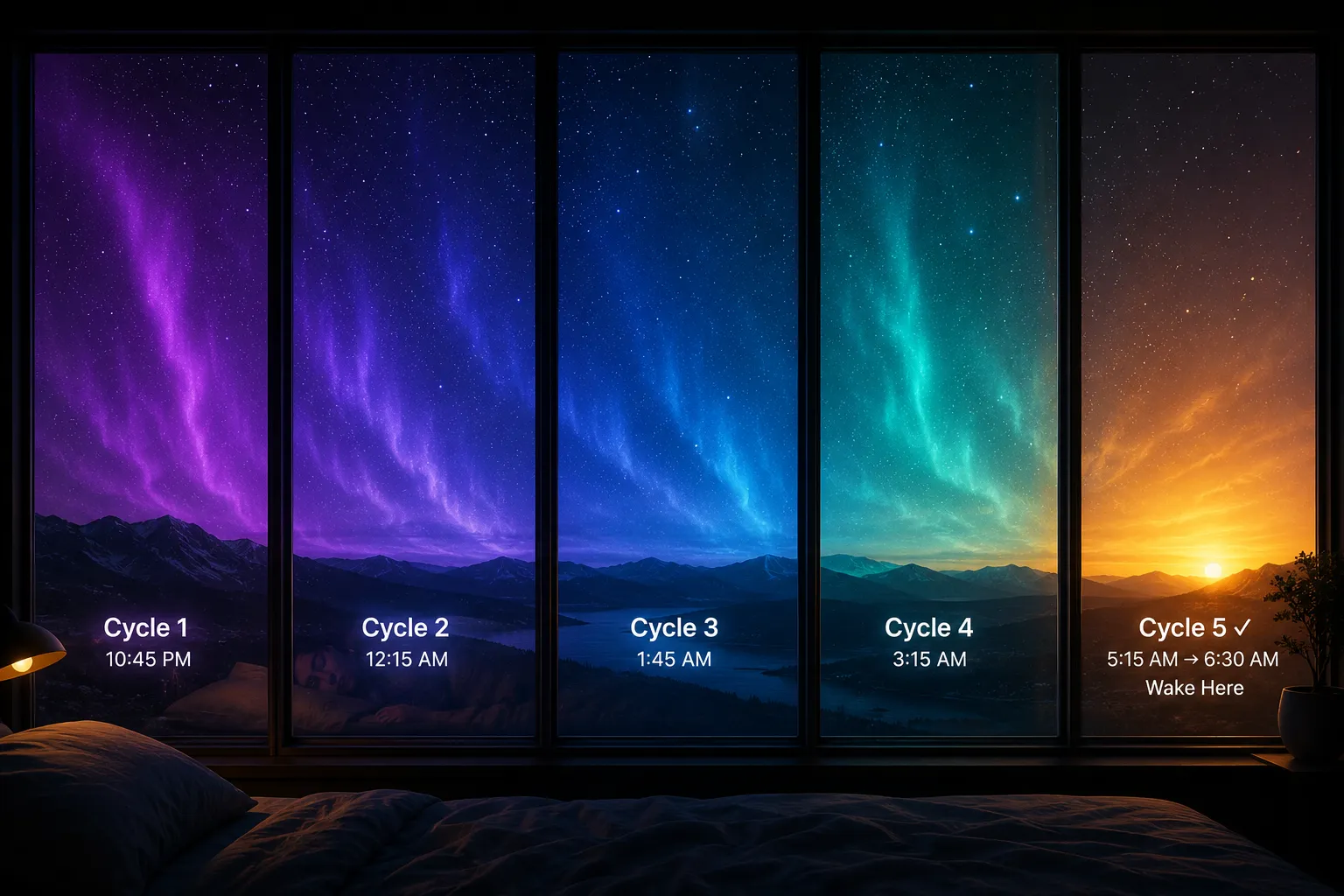
Example: Wake up at 6:30 am
| Cycles | Bedtime | Total Sleep |
|---|---|---|
| 6 cycles | 10:45 pm | 9 hours |
| 5 cycles | 12:15 am | 7.5 hours |
| 4 cycles | 1:45 am | 6 hours |
| 3 cycles | 3:15 am | 4.5 hours |
For most adults, 5 cycles (7.5 hours) is the sweet spot. It sits inside the 7–9 hour recommendation from major sleep health bodies and ends on a natural cycle boundary.
If you know your bedtime, work forwards:
Flip it. Add 15 minutes for sleep onset, then count forward in 90-minute blocks to find your best wake-up windows.
Example: In bed by 10:30 pm (asleep by 10:45 pm)
Best wake-up times: 12:15 am / 1:45 am / 3:15 am / 4:45 am / 6:15 am / 7:45 am
You want to wake up at one of those windows — not somewhere in the middle.
→ Try the free sleep calculator — tell it when you need to wake up and it'll do the maths for you.
What Time Should I Go to Bed? Real Examples
The question sounds simple. The answer depends entirely on when you need to wake up.
If you need to wake up at 5:00 am
Working backwards, adding 15 minutes sleep onset:
- 5 cycles (7.5 hrs): Bedtime → 9:15 pm
- 4 cycles (6 hrs): Bedtime → 10:45 pm
For early risers — shift workers, drivers, nurses, parents of newborns — a 9:15 pm bedtime isn't early, it's just correct. Fighting it with a midnight bedtime and a 5 am alarm is a reliable way to feel destroyed by Wednesday.
If you need to wake up at 6:30 am
- 5 cycles (7.5 hrs): Bedtime → 10:45 pm
- 4 cycles (6 hrs): Bedtime → 12:15 am
If you need to wake up at 7:00 am
- 5 cycles (7.5 hrs): Bedtime → 11:15 pm
- 4 cycles (6 hrs): Bedtime → 12:45 am
Is sleeping 9 pm to 2 am enough?
That's 5 hours — roughly 3 sleep cycles. For most adults, no. You're cutting off your REM sleep, which dominates the later part of the night. You might function short-term, but sleep debt accumulates fast.
Is sleeping 10 pm to 5 am good?
Yes — and here's why. That's approximately 6 hours 45 minutes of actual sleep, landing close to a 4.5-cycle boundary. It also aligns well with the body's circadian rhythm, which prefers sleep between 10 pm and 6 am. Slightly better would be 9:45 pm to land cleanly on the cycle end — but 10 pm to 5 am is a solid night.
How to Calculate Your Sleep-to-Awake Time Ratio (Sleep Efficiency)
Sleep efficiency is a metric used in clinical sleep medicine. It measures how much of your time in bed is actually spent asleep.
The formula:
Sleep Efficiency (%) = (Total Sleep Time ÷ Total Time in Bed) × 100
Example: In bed for 8 hours, but only asleep for 6.5 hours (awake for 1.5 hours in the night):
6.5 ÷ 8 = 0.8125 → 81.25% efficiency
A healthy sleep efficiency is generally 85% or above. Numbers consistently below 80% are worth paying attention to — not a crisis, but worth adjusting your habits or speaking to a doctor if it persists.
What lowers sleep efficiency:
- Lying awake in bed for long stretches
- Waking frequently through the night
- Going to bed too early relative to your natural sleep drive
- Anxiety or screen exposure before bed — both delay sleep onset and fragment cycles
The 90-minute sleep cycle calculator helps here by aligning your bedtime with your actual sleep need, so you spend less time lying awake and more time actually sleeping.
 Lying awake in bed pulls your sleep efficiency below 85% — the threshold where sleep stops being restorative. Timing your bedtime correctly fixes this faster than most sleep hacks.
Sleep Cycle Calculator by Age: How Much Do You Actually Need?
Not everyone needs the same number of cycles. Age changes both the quantity and quality of sleep your body requires.
| Age Group | Recommended Sleep | Approximate Cycles |
|---|---|---|
| Newborns (0–3 months) | 14–17 hours | Cycles not yet regularised |
| Infants (4–11 months) | 12–15 hours | Cycles ~50 min |
| School-age (6–12 years) | 9–11 hours | 6–7 cycles |
| Teenagers (13–17 years) | 8–10 hours | 5–6 cycles; body clock shifts later |
| Adults (18–64 years) | 7–9 hours | 5 cycles is the sweet spot |
| Older adults (65+) | 7–8 hours | Deep sleep naturally decreases |
On teenagers: Their circadian rhythm genuinely shifts later during puberty. This isn't laziness — it's biology. A 15-year-old whose body pushes sleep to midnight isn't broken. Forcing a 9 pm bedtime often just means lying awake, not sleeping earlier. The real target is 8–10 hours ending at a natural cycle boundary.
On women and sleep: Research suggests women experience more slow-wave (deep) sleep on average than men, and hormonal changes across the menstrual cycle, pregnancy, and menopause can shift sleep quality significantly. The 90-minute cycle length stays consistent — but how restorative sleep feels can vary. If you're tracking your sleep, note that pre-menstrual or perimenopausal nights may show more disruption regardless of cycle timing.
Do Sleep Cycle Apps and Websites Actually Work?
Heads up — this is where a lot of people waste money on gadgets they don't need.
The honest answer: Sleep cycle apps work reasonably well. Not perfectly.
Apps that use your phone's microphone or accelerometer detect real signals — when you're deeply asleep you move less, breathe more slowly, and make less noise. They use this to estimate your sleep stage and aim to wake you during lighter sleep.
What they do well:
- Estimating light vs. deep sleep (reasonable accuracy)
- Catching a lighter phase to make waking feel easier
- Logging sleep patterns over time for trends
What they don't do well:
- Precisely identifying NREM sub-stages
- Accounting for a partner's movement (contaminates the data)
- Matching the accuracy of clinical polysomnography (EEG sleep study)
Research published in the Journal of Clinical Sleep Medicine found consumer wearable sleep trackers had reasonable accuracy for detecting sleep vs. wakefulness, but were much weaker at staging specific sleep phases.
The bottom line: A good sleep cycle app is a useful nudge, not a medical device. Pairing one with the 90-minute bedtime method gives you the best of both — plan your bedtime by the maths, let the app catch a slightly better wake window within the final cycle.
Why You Can't Wake Up After Eight Hours
This is one of the most common sleep complaints — and the answer is almost always the same.
Eight hours sounds right. But "eight hours" as a fixed rule ignores when that eight hours ends relative to your cycle.
If your cycles run on the standard 90-minute cadence and you've been asleep for exactly 8 hours, you're 30 minutes into your fifth cycle — right in the middle of Stage 2 or descending into Stage 3. That's one of the hardest stages to wake from. Your brain is mid-process.
The fix is simple: Instead of targeting exactly 8 hours, target 7.5 hours (5 complete cycles) or 9 hours (6 complete cycles). Both land at a natural cycle end. For most people, 7.5 hours feels better than 8 hours, despite being less time in bed.
Hitting snooze makes this worse. Those nine extra minutes don't complete a cycle — they start a new one. You descend back into sleep and get yanked out even earlier in the cycle than before. That's why snoozing tends to leave you groggier than the first alarm would have.
Snoozing is like pausing a movie every nine minutes — you never actually finish the scene, you just keep rewatching the start of it.
 Whether you wake up refreshed or wrecked comes down to one thing — did your alarm land at the end of a cycle or in the middle of one? The 90-minute rule decides that.
How to Use a Sleep Calculator for Shift Work and Split Sleep
Standard sleep advice assumes a standard schedule. Shift workers, split sleepers, and parents of young children know that's not reality.
For split sleep (two shorter sleep periods):
The same 90-minute principle applies to each block separately. A 3-hour sleep block = 2 full cycles. A 4.5-hour block = 3 full cycles. Waking after 2 or 3 hours mid-cycle feels far worse than waking after 3 or 4.5.
For rotating shift workers:
Your circadian rhythm — your body's internal 24-hour clock driven by light and temperature — doesn't adjust as fast as your rota does. The 90-minute calculator still helps you plan when to sleep for maximum cycle completion, but managing light exposure and consistent pre-sleep routines matters more for shift workers than for anyone else.
Nap calculator logic: A power nap should be either 20 minutes (before you reach deep sleep) or a full 90-minute cycle. Anything in between — a 45-minute or 60-minute nap — tends to deposit you in Stage 3 and leaves you with sleep inertia that can last 30–60 minutes after waking. Not the refreshed feeling you were after.
FAQ
How do I calculate my sleep cycle?↓
Count back from your required wake-up time in 90-minute blocks, adding 15 minutes for sleep onset. Each block is one complete cycle. Aim for 5 blocks (7.5 hours) for the standard adult recommendation. For example, if you need to wake at 6:30 am, your ideal bedtime for 5 cycles is 10:45 pm.
How do I calculate my sleep-to-awake time ratio?↓
Use this formula: Sleep Efficiency (%) = (Total Sleep Time ÷ Total Time in Bed) × 100. If you were in bed for 8 hours but only slept 6.5 hours, your efficiency is 81.25%. A healthy target is 85% or above. Below 80% consistently is worth addressing.
Is it enough to sleep at 9 pm and wake up at 2 am?↓
That's approximately 5 hours — around 3 full sleep cycles. For most adults, no. You'll be cutting into your REM sleep, which is heaviest in the later cycles of the night. Short-term you'll manage; long-term, consistently sleeping only 5 hours carries measurable costs to cognition, mood, and immune function.
Is it good to sleep at 10 pm and wake up at 5 am?↓
Yes — it's a solid night for most adults. That's roughly 6 hours 45 minutes of sleep, landing close to a natural 4.5-cycle boundary. It also aligns well with the body's circadian rhythm. Slightly better would be 9:45 pm bedtime to land cleanly on the cycle end, but 10 pm to 5 am is a genuinely good schedule.
What time should I go to bed if I need to get to work at 5 am?↓
If you need to be up by around 4:15 am to get ready, work backwards: for 5 full cycles (7.5 hours) your ideal bedtime is approximately 8:30 pm. For 4 cycles (6 hours), 10:00 pm. Neither feels natural at first — but your body clock will adapt within a few consistent days.
Why can't I wake up after sleeping for eight hours?↓
Because eight hours doesn't always end at a natural cycle boundary. If your cycles run 90 minutes, 8 hours lands you 30 minutes into your fifth cycle — mid-deep sleep. Try 7.5 hours instead. Most people find it easier to wake from, despite being less total time.
Do sleep cycle apps and websites actually work?↓
Reasonably well — but not perfectly. They're good at detecting whether you're in light or deep sleep based on movement and sound. They're weaker at precisely identifying NREM sub-stages. Used alongside cycle-timed bedtimes, they're genuinely useful. Used alone as a substitute for proper sleep planning, they're limited.
Is 7–8 hours of sleep okay for a 15-year-old?↓
It's on the low end. Major sleep health bodies recommend 8–10 hours for teenagers. Importantly, teens' circadian rhythms shift later during puberty — so a 15-year-old sleeping from midnight to 8 am (8 hours, ending on a cycle boundary) is closer to appropriate than a 9 pm–5 am schedule that leaves them lying awake for hours.
Is there a way to need less sleep?↓
Not sustainably for most people. Sleep need is largely genetic. A small number of people carry a gene variant that allows genuine function on 6 hours — but they're rare. For everyone else, trying to chronically under-sleep just builds hidden debt that degrades performance, mood, and long-term health. The better goal is better-timed sleep, not less of it.
Try the Sleep Calculator for Your Schedule
The numbers in this post are the same logic the free sleep calculator uses — just done automatically for your exact wake-up or bedtime.
Tell it when you need to wake up, and it'll show you the best bedtimes, calculated to the exact cycle, with the 15-minute sleep-onset already factored in. No maths. No guessing. Just the right time for your night.
→ Use the free 90-minute sleep cycle calculator at GetSleepCalculator.net
Sources: Sleep stage and cycle data referenced from the American Academy of Sleep Medicine (AASM). Recommended sleep durations by age from the National Sleep Foundation. Sleep tracker accuracy referenced from Kahawage et al., Journal of Clinical Sleep Medicine, 2020.
Calculate Your Perfect Sleep & Wake Times
Put this research into practice immediately. Our scientific calculators align your sleep with natural 90-minute REM cycles.
Related Articles
Why Sleep Is Important for Health: 10 Science-Backed Reasons
Sleep affects your brain, heart, immune system, weight, and mental health. Discover 10 proven reasons why sleep is essential for health — backed by NSF, CDC, and AASM research.
7 min read read →how long can a human go without sleep?
Wondering if you can survive 7 days without sleep? Discover the extreme physical and psychological stages of severe sleep deprivation and what happens to your body.
4 min read read →Sleep Calculator: How Many Hours of Sleep Do You Really Need?
Find out exactly how many hours of sleep you need by age. Use our free sleep calculator to get your perfect bedtime and wake-up time — backed by NHS guidelines.
9 min read read →