
Fact-Checked & Clinical Guidelines Aligned
Content rigorously reviewed to ensure alignment with clinical guidelines published by the National Sleep Foundation (NSF) and the American Academy of Sleep Medicine (AASM).
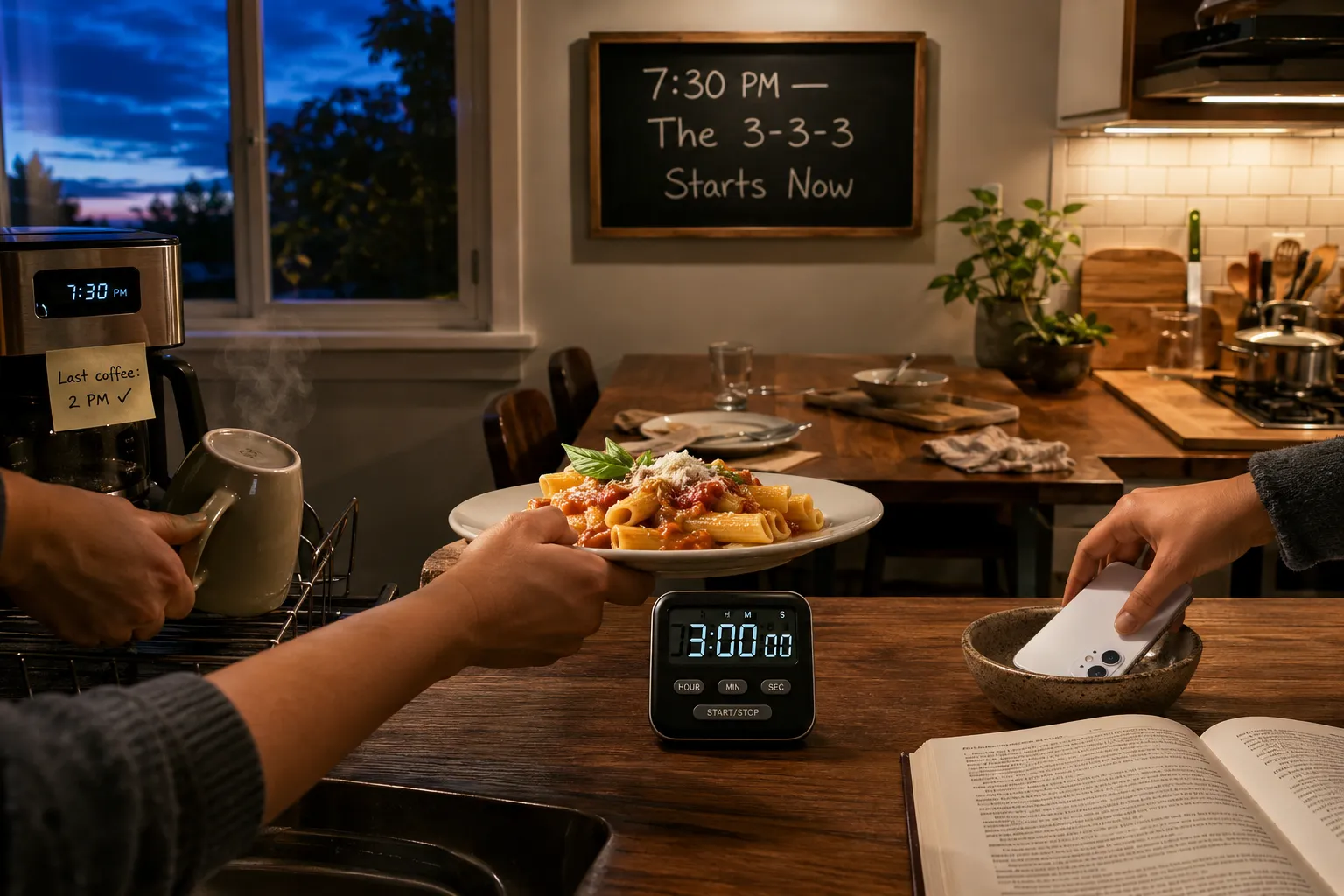
The 3-3-3 Rule for Sleep
The 3-3-3 sleep rule tells you exactly what to stop doing before bed. Here's the science behind each "3" and how to use it to fall asleep faster tonight.
You’ve tried everything.
No caffeine after noon. Melatonin at 9 PM. A white noise machine that sounds like you’re sleeping inside a dishwasher. A weighted blanket heavy enough to anchor a small boat. Lavender spray on the pillow. A “relaxing” bedtime routine that somehow takes 45 minutes and leaves you more alert than when you started.
And yet. You lie there. Awake. At 11:47 PM. Thinking about an email you forgot to send, a meeting tomorrow, whether you locked the car, and — at some point — the fact that you’re now thinking so hard about sleeping that you’ve made sleeping impossible.
Here’s something nobody told you: the problem usually isn’t what you do in bed. ** It’s what you did in the three hours before you got there.
The 3-3-3 rule for sleep fixes exactly that. It’s not a supplement, a gadget, or a complicated routine. It’s three simple cutoffs — each backed by sleep science — that tell you what to stop doing and when, so your brain and body actually arrive at bedtime ready to sleep, not ready for round two of the working day.
Here’s what it is, why each part works, and — honestly — which parts of it are slightly overstated.
What Is the 3-3-3 Rule for Sleep?
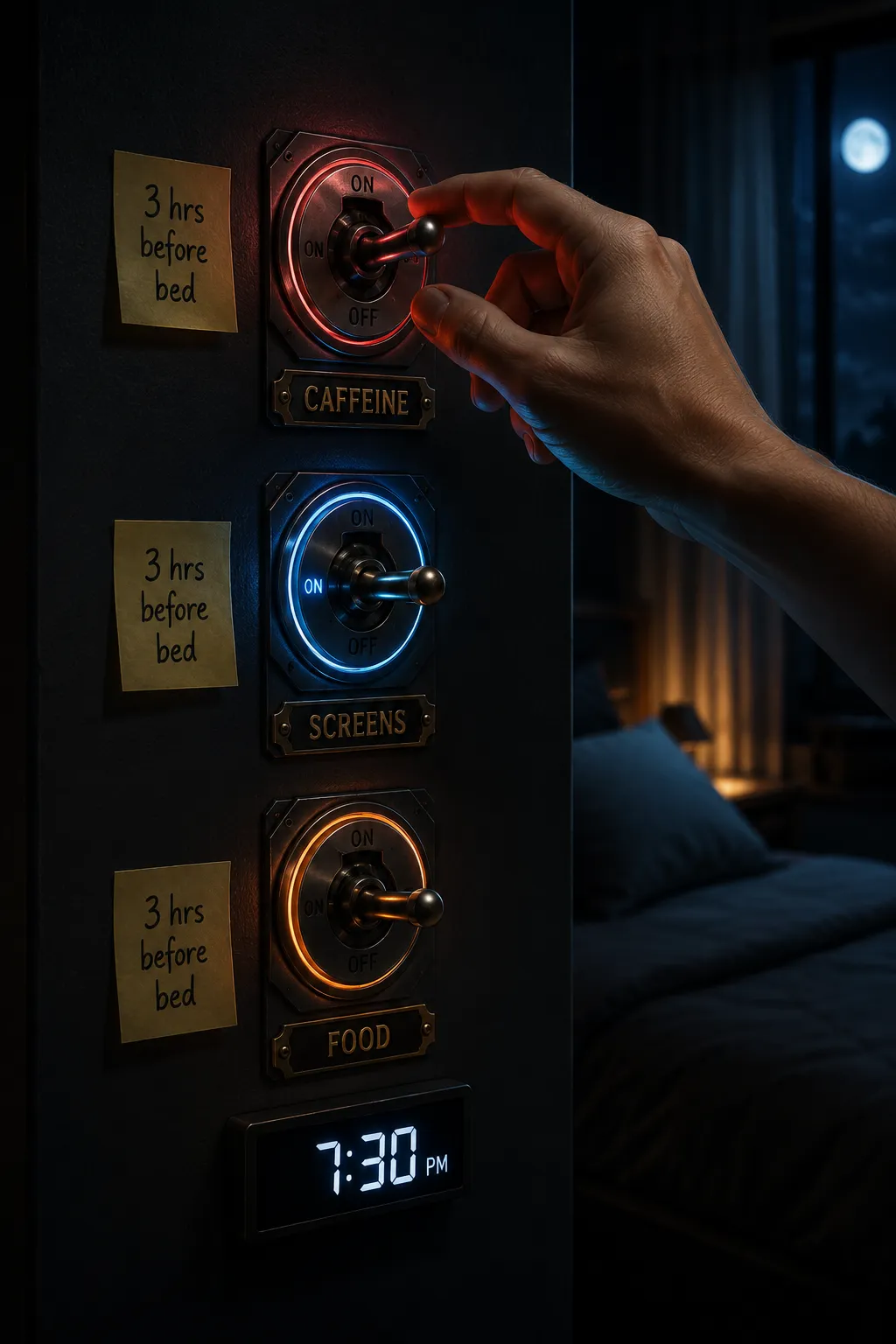
The 3-3-3 rule is a pre-sleep framework built around three cutoff points, each timed three hours before your intended bedtime:
No caffeine 3 hours before bed. ** **** No food for 3 hours before bed. No screens for 3 hours before bed.**
Some extended versions add:
**No intense exercise 3 hours before bed. **** No alcohol 3 hours before bed. **** No work for 3 hours before bed.
The logic behind all of them is the same: your brain and body need a wind-down runway. Sleep doesn’t switch on like a light — it’s a gradual biological process that requires your core body temperature to drop, your melatonin levels to rise, your cortisol to fall. Your nervous system to shift from sympathetic (fight-or-flight, alert, productive) to parasympathetic (rest-and-digest, calm, sleepy).
Every item on the 3-3-3 list interrupts one or more of those processes. Stop doing them three hours out, and you give your biology the runway it needs.
Simple in theory. Slightly more complicated in practice — especially the screens one. But we’ll get to that.
The First 3: No Caffeine 3 Hours Before Bed
Let’s start with the one most people think they’ve already nailed — and haven’t.
Caffeine works by blocking adenosine receptors in the brain. Adenosine is the chemical that builds up throughout the day and creates sleep pressure — the biological drive to sleep. The longer you’re awake, the more adenosine accumulates, the sleepier you feel. Caffeine doesn’t clear the adenosine. It just sits in the receptor and stops you feeling it. The moment the caffeine clears, all that adenosine hits at once — which is why the post-caffeine crash can feel so sudden.
Here’s the number that changes everything: caffeine has a half-life of approximately 5–6 hours in most adults. That means half the caffeine from a 3 PM coffee is still active in your system at 9 PM. A quarter of it is still there at midnight.
**The 3-hour rule isn’t aggressive enough for most people. ****
Sleep researchers at the University of Michigan found that caffeine consumed even 6 hours before bedtime reduced total sleep time by more than one hour. The 3-3-3 rule sets the cutoff at 3 hours — but for anyone sensitive to caffeine or whose bedtime is before 11 PM, cutting off at 1–2 PM is more realistic.
Drinking coffee at 4 PM and wondering why you can’t sleep at 10 PM is like flooring the accelerator and then being surprised that the car won’t stop immediately. The physics don’t care about your intentions.
The practical cutoff for most people:
- Light caffeine sensitivity: 3 hours before bed
- Average: 6 hours before bed (early afternoon)
- High sensitivity: After midday only
What counts as caffeine (that people forget):
- Coffee — obviously
- Tea — black, green, and white all contain caffeine
- Energy drinks — often more caffeine than coffee
- Pre-workout supplements — frequently very high caffeine
- Some soft drinks — cola and some lemon sodas
- Dark chocolate — lower but real caffeine content
- Some headache medications — check the label
The Second 3: No Food 3 Hours Before Bed
This one is less about sleep onset and more about sleep quality — and the science is more nuanced than the rule suggests.
Eating a large meal close to bedtime raises your core body temperature through the digestive process, makes you more likely to experience acid reflux when lying horizontal, and keeps your metabolism running at a rate that’s incompatible with the deep, restorative sleep stages your body needs.
Core body temperature is critical here. To fall asleep and stay in deep slow-wave sleep, your body needs to drop its core temperature by approximately 1–2°C. Digestion actively works against this — it generates heat. A large meal two hours before bed can delay sleep onset by keeping your body temperature elevated past the window where sleep would naturally arrive.
The specific villain is large, heavy meals — particularly those high in fat and protein, which take the longest to digest. A full dinner at 9 PM when you’re trying to sleep at 10 PM is a genuine problem.
What the 3-3-3 rule gets right: A three-hour gap between a full dinner and bedtime is well-supported by research. Your digestive system will have done most of its heavy lifting, your core temperature will have returned toward baseline, and reflux risk is significantly reduced.
Where the rule is slightly overstated: A light snack — particularly something containing tryptophan (the amino acid precursor to serotonin and melatonin) — close to bedtime can actually help sleep rather than hinder it. A small bowl of oats, a banana, a handful of almonds, or warm milk are all genuinely sleep-supportive in small quantities within an hour of bedtime.
The rule should more accurately be: **no large meals 3 hours before bed. **** Light, sleep-supportive snacks are fine.
The foods most likely to disrupt sleep close to bedtime:
- High-fat meals (slow to digest, temperature-raising)
- Spicy food (acid reflux risk multiplied when horizontal)
- High-sugar foods (blood sugar spike followed by crash can cause night waking)
- Alcohol — discussed separately below
The Third 3: No Screens 3 Hours Before Bed
Here it is. The one everybody knows they should do and almost nobody actually does.
Three hours without screens before bed sounds, to most people, like being asked to give up a limb. Phones are how we wind down, stay connected, catch up on the day, watch one more episode, check one more thing — and then somehow it’s midnight.
The science has two distinct arguments against screens before bed, and they’re both real:
Argument 1: Blue light suppresses melatonin. Screens emit blue-wavelength light, which signals to the suprachiasmatic nucleus — the brain’s master circadian clock — that it is daytime. This suppresses the release of melatonin, the hormone that initiates sleep. Research from Harvard Medical School found that blue light suppresses melatonin for roughly twice as long as green light and shifts circadian rhythms by up to three hours.
**Argument 2: The content keeps your brain alert. **** This is the argument that doesn’t get enough attention. Even if you solve the blue-light problem with night mode or blue-light glasses, the content you’re watching or scrolling keeps your brain in a state of active engagement — the opposite of what’s needed for sleep onset. Social media creates micro-doses of reward and anxiety. News creates stress. Even funny videos create arousal. Your nervous system doesn’t distinguish between “stimulating content that’s enjoyable” and “stimulating content that’s stressful” — both keep you alert.
Is three hours realistic?
Honestly — for most people, no. Not immediately. Three hours is the optimal window. One hour is a meaningful improvement over nothing. The goal isn’t perfection; it’s direction.
If three hours feels impossible, start with one. Move to 90 minutes when one hour feels manageable. Work toward two hours. The sleep improvement compounds with every extra increment of screen-free time before bed.
“I’ll just check one thing” has ended more good nights of sleep than any cup of coffee ever did. The phone doesn’t have an off switch for your brain. You have to provide one manually.
What to do instead of screens:
- Read a physical book (the single most evidence-supported pre-sleep activity)
- Have a conversation
- Take a warm bath or shower (raises then drops body temperature — actually speeds sleep onset)
- Light stretching or yoga — gentle only
- Listen to a podcast or audiobook with the screen off
- Write in a journal — particularly effective for offloading the racing thoughts that keep people awake
The Extended 3-3-3: Three More Worth Knowing
The core rule covers caffeine, food, and screens. The extended version adds three more that deserve attention:
No Intense Exercise 3 Hours Before Bed
Exercise raises core body temperature, elevates cortisol, and increases heart rate — all of which are incompatible with sleep onset. The body needs time to return to baseline after intense physical activity.
The nuance: Light exercise — walking, gentle yoga, stretching — is sleep-neutral or even beneficial close to bedtime. It’s high-intensity training (running, weightlifting, HIIT) that needs the three-hour buffer. Morning or early afternoon exercise is significantly better for sleep than evening workouts for most people.
The myth to bust: “I sleep fine after evening exercise” — some people do, genuinely. Individual variation is real here. But population-level data consistently shows better sleep quality in people who exercise earlier in the day. If you’re struggling with sleep and you train in the evenings, it’s worth experimenting with timing.
No Alcohol 3 Hours Before Bed
Alcohol is sleep’s most convincing liar.
It helps you fall asleep faster — genuinely. The sedative effect of alcohol reduces sleep onset time, which looks like a win. But alcohol significantly disrupts the second half of the night: it suppresses REM sleep, increases night wakings, raises body temperature, and causes earlier-than-desired morning waking as blood alcohol levels drop.
The net result: you fall asleep quickly, sleep shallowly, wake at 4 AM feeling like you’ve been lightly processed, and spend the morning convinced the problem was “bad sleep” rather than last night’s wine.
Three hours isn’t always enough for alcohol to clear the system fully — a rough rule of thumb is one hour per unit consumed. But stopping three hours before bed significantly reduces the sleep-disrupting effects compared to drinking right up to bedtime.
No Work 3 Hours Before Bed
This is the hardest one for anyone who works from home, runs their own business, or has a job that follows them everywhere via a phone.
Work activates the prefrontal cortex — the planning, problem-solving, decision-making part of the brain — and elevates cortisol as it processes deadlines, emails, and unresolved tasks. Neither of those things is compatible with the nervous system downshift required for sleep.
The specific problem isn’t just cortisol — it’s cognitive arousal. When you’re working, your brain is generating and tracking open loops: unfinished tasks, pending decisions, things to remember tomorrow. These open loops don’t close when you close the laptop. They keep running in the background — which is exactly what produces the lying-awake-at-midnight thought spiral most people know intimately.
A shutdown ritual — a specific routine that signals to your brain that work is over for the day — is one of the most underrated sleep interventions available. It doesn’t need to be elaborate. Write tomorrow’s task list. Close every tab. Say out loud: “work is done.” Sounds ridiculous. Works surprisingly well.
How to Apply the 3-3-3 Rule to Your Actual Schedule
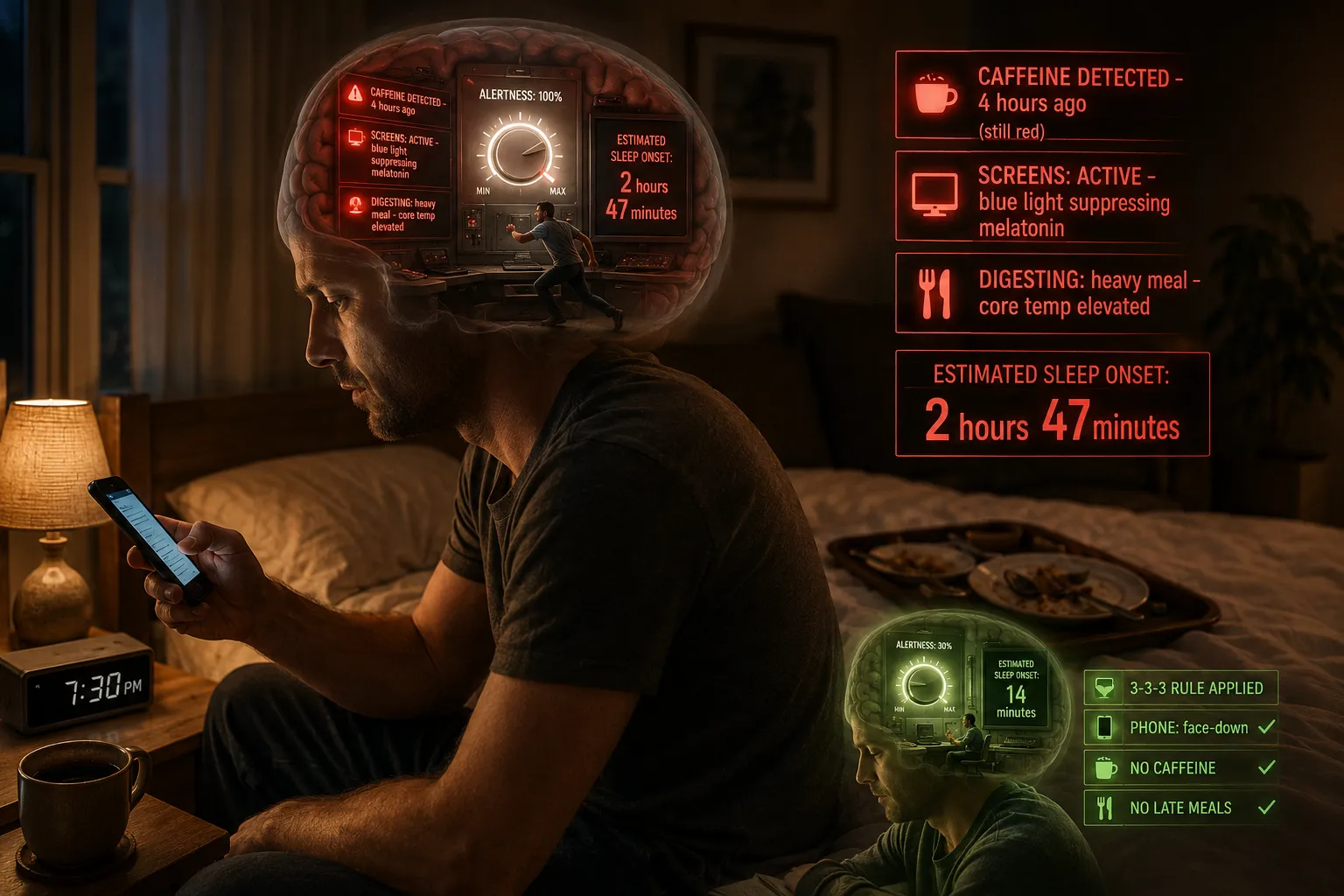
Here’s how it works in practice. Take your target bedtime and count back:
Example: Bedtime 10:30 PM
| Cutoff | Time |
|---|---|
| No work after | 7:30 pm |
| No intense exercise after | 7:30 pm |
| No large meal after | 7:30 pm |
| No alcohol after | 7:30 pm |
| No caffeine after | 7:30 pm (ideally earlier — 2–3 pm) |
| No screens after | 7:30 pm (aim for this; 9:30 pm is still meaningful) |
Example: Bedtime 11:30 PM
| Cutoff | Time |
|---|---|
| No work after | 8:30 pm |
| No intense exercise after | 8:30 pm |
| No large meal after | 8:30 pm |
| No alcohol after | 8:30 pm |
| No caffeine after | 8:30 pm (ideally 2–3 pm) |
| No screens after | 8:30 pm |
The most important thing: you don’t have to implement all six perfectly from night one. Pick the one that’s most relevant to your biggest sleep problem and start there. Screens for most people. Caffeine timing for afternoon drinkers. Food for late-night eaters. One change, consistently applied, will move your sleep quality more than six changes attempted half-heartedly for three days.
What the 3-3-3 Rule Doesn't Fix
In fairness — and because this post has opinions — here’s what the 3-3-3 rule won’t solve on its own:
**It won’t fix a broken sleep schedule. **** If your wake time shifts by 3 hours between weekdays and weekends, your circadian rhythm is never properly anchored. The 3-3-3 rule optimises your wind-down window — but that window needs to be at a consistent time to be effective. Fix your wake time first.
It won’t fix conditioned arousal. If you’ve spent months lying awake in bed, your brain may have learned to associate the bed with wakefulness rather than sleep — a phenomenon called conditioned arousal. ** The 3-3-3 rule helps prevent new arousal before bed; it doesn’t reverse existing conditioning. ** For that, CBT-I (cognitive behavioural therapy for insomnia) is the evidence-based treatment.
It won’t fix sleep apnoea. If you’re snoring heavily, waking gasping, or feeling unrefreshed despite adequate hours — no lifestyle rule will fix that. ** It requires medical evaluation.
It won’t fix chronic sleep debt overnight. If you’re carrying weeks of accumulated sleep debt, the 3-3-3 rule will improve your sleep quality from the first night — but full cognitive and physical restoration takes weeks of consistent, adequate sleep. ** Think of it as fixing the leak, not bailing out the boat.
FAQ
What is the 3-3-3 rule for sleep?↓
The 3-3-3 sleep rule is a pre-bedtime framework with three core cutoffs, each timed three hours before bed: no caffeine, no large meals, and no screens. Extended versions add no intense exercise, no alcohol, and no work in the same window. The goal is to give your brain and body the wind-down runway they need — allowing core body temperature to drop, melatonin to rise, and cortisol to fall before you attempt to sleep.
Does the 3-3-3 sleep rule actually work?↓
Yes — with caveats. Each of the three core elements is individually supported by sleep research. Caffeine’s half-life of 5–6 hours justifies a pre-bed cutoff (though three hours is arguably too short for many people). Large meals close to bedtime raise core body temperature and increase the risk of reflux. Screen blue light suppresses melatonin, and the content keeps the brain alert. Applied consistently, the 3-3-3 rule addresses three of the most common behavioural causes of sleep difficulty in one simple framework.
Is three hours without screens before bed realistic?↓
For most people, not immediately. Three hours is the optimal window, given how long blue light suppression and cognitive arousal persist after screen use. One hour is a meaningful improvement over none. Start with 30–60 minutes of screen-free time before bed, build the habit, and gradually extend it. The sleep improvement compounds with each additional increment of screen-free time.
What can I do instead of screens before bed?↓
Read a physical book — the most evidence-supported pre-sleep activity available. Other good options: take a warm bath or shower (the temperature drop afterwards speeds sleep onset), light stretching or gentle yoga, journalling (particularly effective for offloading racing thoughts), listening to a podcast or audiobook with the screen off, or simply having a conversation. The goal is low stimulation, low light, and low cognitive demand.
Can I eat anything before bed or nothing at all?↓
The 3-3-3 rule targets large meals — not all food. A light snack containing tryptophan (a banana, small bowl of oats, handful of almonds, warm milk) close to bedtime is sleep-neutral to mildly beneficial. It’s heavy, high-fat, high-protein, or spicy meals that disrupt sleep by elevating core body temperature and increasing the risk of reflux. Three hours between a full dinner and bedtime is the science-backed minimum.
Does the 3-3-3 rule work for people with insomnia?↓
It helps, but it’s not sufficient on its own for clinical insomnia. The 3-3-3 rule addresses behavioural sleep disruptors before bed; it doesn’t address the conditioned arousal, dysfunctional sleep beliefs, and circadian dysregulation that drive chronic insomnia. For persistent insomnia (difficulty sleeping three or more nights per week for three or more months), CBT-I (cognitive behavioural therapy for insomnia) is the first-line evidence-based treatment — more effective than sleep medication and longer-lasting.
What about the 10-3-2-1-0 sleep rule — is it better?↓
The 10-3-2-1-0 rule is an extended version: no caffeine 10 hours before bed, no food or alcohol 3 hours before, no work 2 hours before, no screens 1 hour before, and 0 snooze button hits in the morning. It’s more aggressive and more precise — the 10-hour caffeine cutoff is actually more aligned with caffeine’s true half-life than the 3-hour version. The 3-3-3 rule is more memorable and more accessible as a starting framework. If you’ve mastered the 3-3-3 and want to optimise further, the 10-3-2-1-0 is worth considering.
How does the 3-3-3 rule connect to sleep cycle timing?↓
The 3-3-3 rule optimises your wind-down window so you fall asleep at the right time. Sleep cycle timing — the 90-minute cycle structure that determines whether your alarm wakes you refreshed or groggy — operates independently but complementarily. The 3-3-3 rule helps you fall asleep. The sleep calculator ensures you wake up at the end of a cycle rather than in the middle of one. Together, they cover both sides of a good night’s sleep.
Start Tonight. Pick One Thing.
The 3-3-3 rule is not a personality transformation. It’s not a 45-minute bedtime routine with seventeen steps. It’s three cutoffs, timed three hours before bed, applied consistently.
You don’t have to do all six perfectly from tonight. Pick the one that describes your biggest problem most accurately:
- Still drinking coffee at 5 PM? Start there.
- Eating dinner at 9 PM and sleeping at 10? Start there.
- Scrolling until your eyes close? Definitely start there.
One change. Consistently applied. Every night this week. Then add the next one.
And once you know what time you’re going to bed, use the sleep calculator to make sure your bedtime aligns with your sleep cycles, because falling asleep at the right time is only half the equation. Waking up at the right point in your cycle is the other half.
Sources: Caffeine half-life and sleep impact from Drake et al., Journal of Clinical Sleep Medicine, 2013. Blue light melatonin suppression from Tosini et al., Molecular Vision, 2016. Harvard Medical School blue light study, 2020. Body temperature and sleep onset from Raymann et al., Brain, 2008. Alcohol and REM sleep suppression from Ebrahim et al., Alcoholism: Clinical and Experimental Research, 2013. CBT-I evidence base from Trauer et al., Annals of Internal Medicine, 2015.
Calculate Your Perfect Sleep & Wake Times
Put this research into practice immediately. Our scientific calculators align your sleep with natural 90-minute REM cycles.
Related Articles
Why Sleep Is Important for Health: 10 Science-Backed Reasons
Sleep affects your brain, heart, immune system, weight, and mental health. Discover 10 proven reasons why sleep is essential for health — backed by NSF, CDC, and AASM research.
7 min read read →how long can a human go without sleep?
Wondering if you can survive 7 days without sleep? Discover the extreme physical and psychological stages of severe sleep deprivation and what happens to your body.
4 min read read →Sleep Calculator: How Many Hours of Sleep Do You Really Need?
Find out exactly how many hours of sleep you need by age. Use our free sleep calculator to get your perfect bedtime and wake-up time — backed by NHS guidelines.
9 min read read →