

Fact-Checked & Clinical Guidelines Aligned
Content rigorously reviewed to ensure alignment with clinical guidelines published by the National Sleep Foundation (NSF) and the American Academy of Sleep Medicine (AASM).
The Safe Sleep 7: How to Safely Co-Sleep When You’re Exhausted
Desperate for sleep with a newborn? Learn the famous Safe Sleep Seven guidelines by La Leche League for safe bed-sharing, reducing SIDS risks, and saving your sanity.
Let’s be honest. Before you had a baby, you probably swore you would never, ever let your infant sleep in your bed. You bought the beautiful $300 bassinet. You washed the organic cotton sheets. You were ready.
And then... the baby arrived. And suddenly, it’s 3:00 AM, you haven't slept more than two consecutive hours in a week, and your newborn screams the absolute second their back touches that expensive bassinet mattress.
You are rocking them in a chair, fighting the heavy pull of your eyelids, terrified you might drop them. You think: "If I just bring them into bed, we could both finally sleep." But then the guilt and fear set in. Is it safe?
If you are carrying a massive amount of sleep debt, you are not alone. And thankfully, there are actual, science-backed rules to help you survive this phase. Enter: The Safe Sleep Seven.
What is the Safe Sleep 7?
The Safe Sleep Seven is a set of strict guidelines developed by La Leche League International (LLLI), one of the most respected maternal health organizations in the world.
The reality is that exhausted parents bed-share. Period. Whether by accident on a dangerous sofa, or intentionally in a bed, it happens. The Safe Sleep 7 was created to acknowledge this reality and give parents a checklist. If you meet all seven of these criteria, the risk of SIDS (Sudden Infant Death Syndrome) for a nursing baby bed-sharing with their mother is statistically similar to a baby sleeping alone in a crib.
Let's break them down.
The 7 Rules for Safe Bed-Sharing
1. You are a Non-Smoker
This is non-negotiable. Smoking during pregnancy or after the baby is born significantly increases the risk of SIDS. If anyone in the bed is a smoker (even if they smoke outside), bed-sharing is not safe.
2. You are Sober and Unimpaired
If you’ve had a glass of wine, are taking heavy prescription pain medication, or even just took NyQuil to fight off a cold, you cannot bed-share. Your natural maternal instincts and physical awareness are dulled.
3. You are a Breastfeeding Mother
This one surprises a lot of people! Why does breastfeeding matter for sleep safety? Breastfeeding mothers and babies naturally sync up their sleep cycles. Furthermore, a nursing mother naturally curls around her baby in a "C-shape" (also known as the "cuddle curl"), with her knees tucked up and arm under her head. This position prevents her from rolling onto the baby and keeps the baby from scooting up or down the bed.
4. Your Baby is Healthy and Full-Term
Premature babies or babies born with low birth weights are more vulnerable and lack the muscle tone needed to clear their airways if they get too close to a mattress or blanket. They need the absolute flat, isolated safety of a bassinet.
5. Your Baby is Sleeping on Their Back
Always, always, always on their back. Not on their side, not on their tummy, and definitely not sleeping on your chest while you sleep (that is highly dangerous if you roll).
6. No Sweat: Keep Baby Lightly Dressed
Babies cannot regulate their body temperature as well as adults, and overheating is a known SIDS risk factor. Do not bundle them in fleece or heavy swaddles if they are sharing your body heat. A light onesie is usually enough.
7. A Safe Surface (The Firm Mattress)
This might be the hardest one for adults who love "cloud-like" memory foam. The mattress must be firm. No waterbeds, no sagging memory foam, no sleeping on the couch (couches are incredibly dangerous for infants).
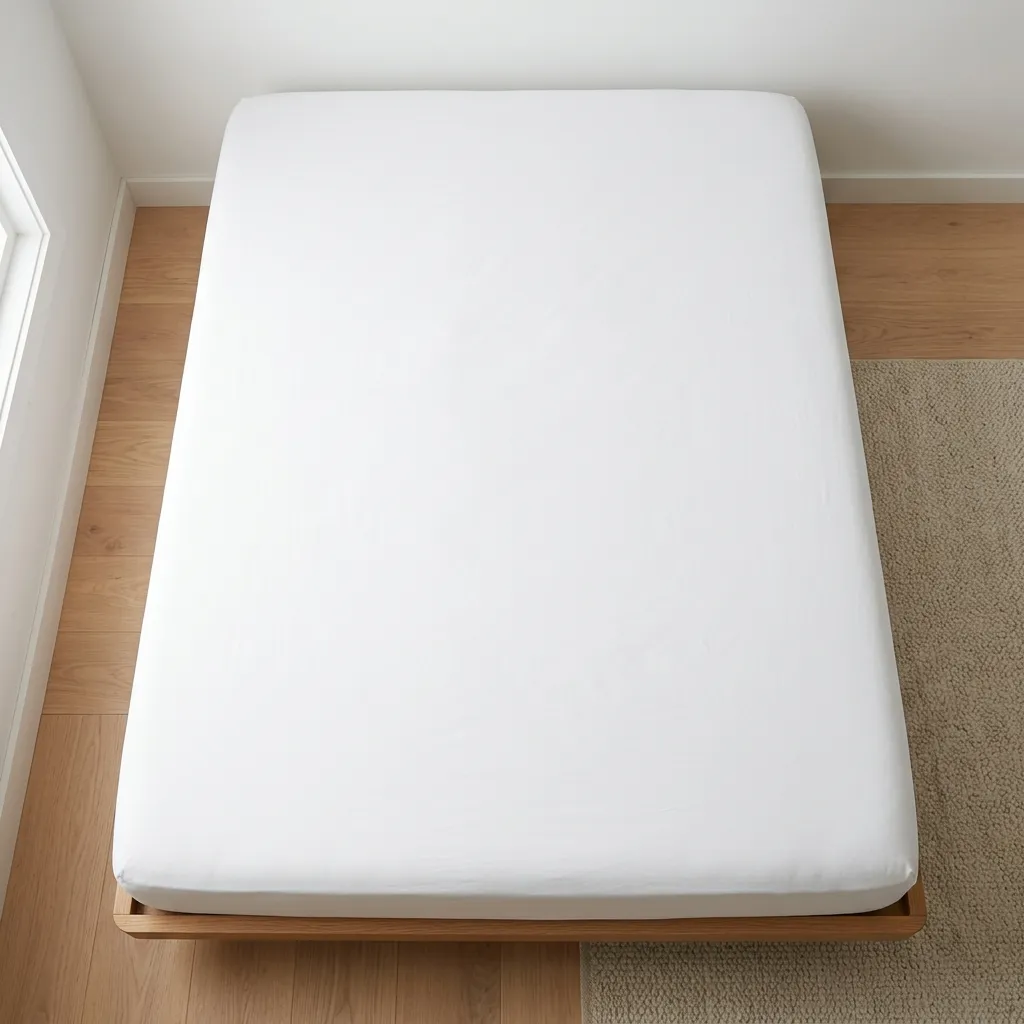
The Golden Rule: Clear the Bed
If you meet all the criteria above, you still need to prepare the "landing zone." A safe sleep bed looks incredibly boring.
- No big fluffy pillows near the baby.
- No heavy duvets pulled up high.
- No gaps between the mattress and the wall.
It should just be a firm mattress, a tight fitted sheet, and you.
Tracking Your Recovery
If you've been fighting the bassinet battle for weeks, your sleep architecture is likely a mess. Once you establish a safe sleep routine—whether that means successfully using the Safe Sleep 7 or finally getting your baby to accept the crib—you need to focus on your own recovery.
Use our Bedtime Calculator to figure out exactly when you should try to sleep between feeding sessions to catch full 90-minute REM cycles. You will feel remarkably less groggy if you wake up at the end of a cycle rather than in the middle of deep sleep!
Important Medical Disclaimer: This article is for informational purposes only. The safest place for a baby to sleep is always on their back, on a firm, flat surface in a crib or bassinet in the same room as the parents, according to the American Academy of Pediatrics (AAP). Always consult with your pediatrician before making changes to your infant's sleep environment.
Parenting is exhausting, but it won't be like this forever. You're doing a great job.
Can my partner sleep in the bed too?↓
Yes, but the baby should always be between the breastfeeding mother and the edge of the bed (with safe guardrails) or between the mother and the wall (with absolutely no gaps). The baby should not be placed between the mother and the partner, as partners do not have the same instinctual "cuddle curl" awareness during deep sleep.
What if I formula feed?↓
The Safe Sleep 7 specifically highlights breastfeeding because of the instinctual sleep positioning (the cuddle curl) and the lighter sleep cycles it promotes. If you formula feed, experts and the AAP strongly recommend utilizing a bassinet or bedside co-sleeper rather than bringing the baby into the adult bed.
Calculate Your Perfect Sleep & Wake Times
Put this research into practice immediately. Our scientific calculators align your sleep with natural 90-minute REM cycles.
Related Articles
Why Sleep Is Important for Health: 10 Science-Backed Reasons
Sleep affects your brain, heart, immune system, weight, and mental health. Discover 10 proven reasons why sleep is essential for health — backed by NSF, CDC, and AASM research.
7 min read read →how long can a human go without sleep?
Wondering if you can survive 7 days without sleep? Discover the extreme physical and psychological stages of severe sleep deprivation and what happens to your body.
4 min read read →Sleep Calculator: How Many Hours of Sleep Do You Really Need?
Find out exactly how many hours of sleep you need by age. Use our free sleep calculator to get your perfect bedtime and wake-up time — backed by NHS guidelines.
9 min read read →